Curiosity Rover Continues Drilling at Nazca Site
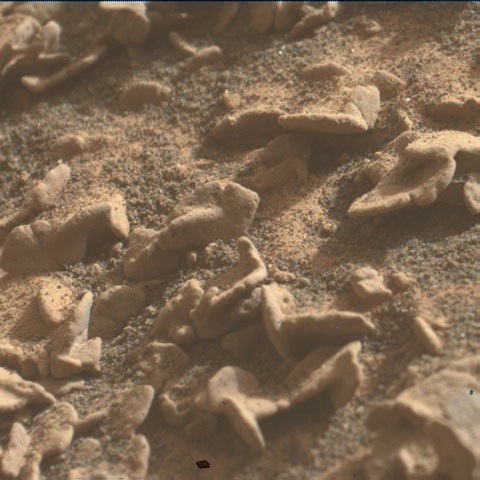
NASA’s Curiosity rover has recently engaged in drilling activities at the “Nazca” site on Mars, a location noted for its distinctive bedrock featuring chip-like crystal formations. The rover utilized its Mars Hand Lens Imager (MAHLI) to capture detailed images of these crystal shapes on November 7, 2026, marking Sol 5067 of its mission.
Objectives and Activities
During this period, Curiosity focused on analyzing the unique chip-shaped features present at the drill site. The samples collected were sent to the Sample Analysis for Mars (SAM) instrument for further examination. While SAM conducted its analysis, the mission team planned additional observations, including a ChemCam laser-induced breakdown spectroscopy (LIBS) scan of another crystal formation identified as “Ahi Veremos.” The rover also aimed to create a comprehensive mosaic of the surrounding area using its Mastcam.
The week’s activities included a variety of scientific tasks. On Wednesday, Curiosity executed two targeted science blocks, conducting LIBS depth profiling on the “Colca” crystal and additional LIBS observations on the “Bermejo” target. The rover captured a long-distance mosaic of rock clusters beneath the “Cordillera” ridge with its Remote Micro-Imager (RMI) and continued to gather environmental data.
Future Plans and Continued Exploration
Looking ahead, the planning for Friday involved three sols and featured multiple targeted science blocks, along with a planned move away from the Nazca drill site. The team organized a MAHLI mosaic of the drill hole’s side and scheduled nighttime imaging of the crystal formations using MAHLI’s white-light and ultraviolet LED lamps. Notably, the rover prioritized capturing images of Mars’ moon, Phobos, as it eclipsed the Sun during the week.
ChemCam LIBS observations were slated for each sol, targeting various geological features, including a cluster of crystals, a resistant layer on the Nazca block, and a dark float rock. Another RMI mosaic was to be produced, focusing on dark lenses located beneath a planar surface on the “Mishe Mokwa” ridge. Additionally, environmental observations remained a key aspect of the mission as Curiosity continued its exploration across the Martian landscape.
Source: NASA