Hubble’s Gravitational Lensing Insights for Roman Telescope
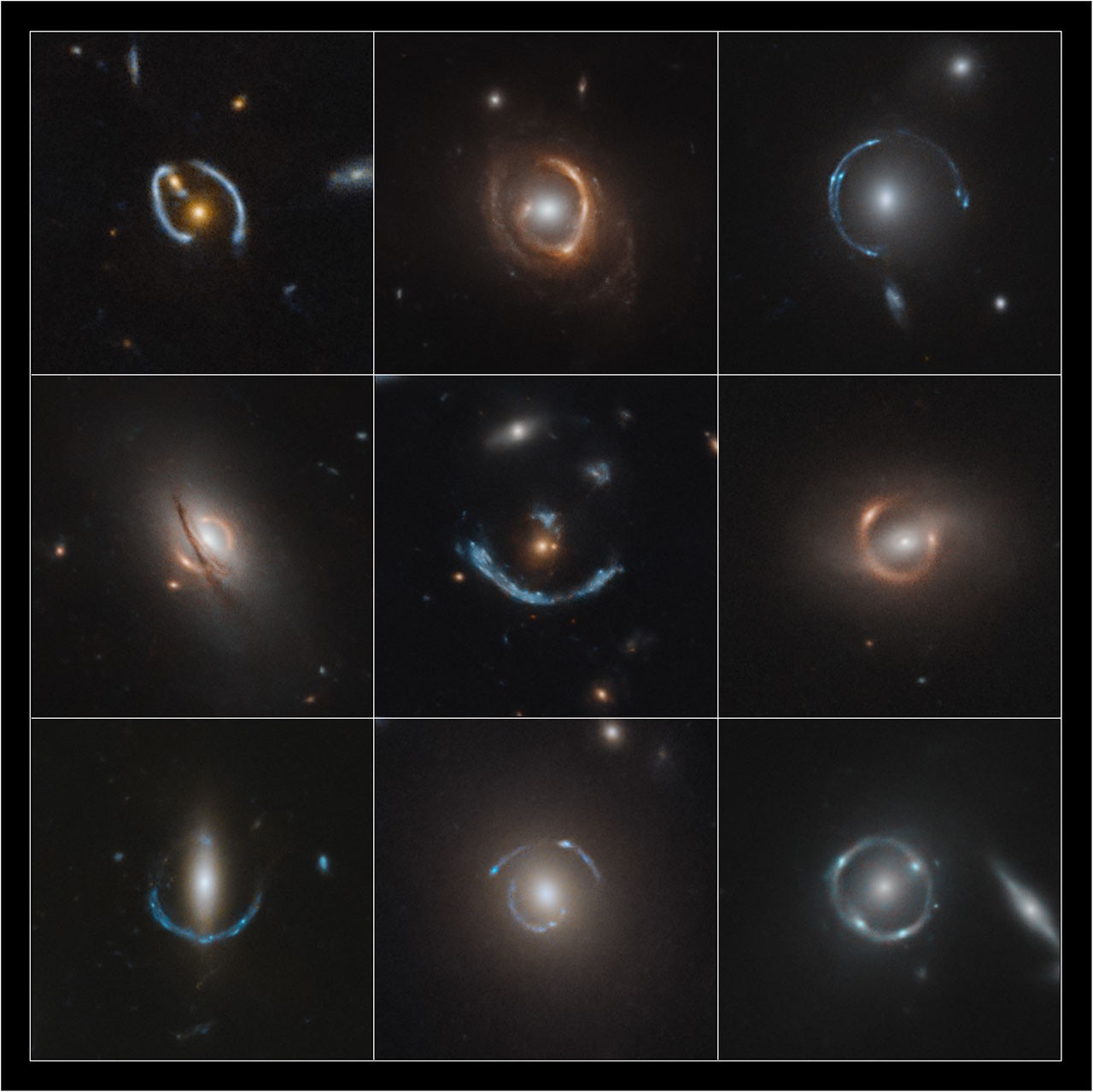
A recent collection of images from NASA’s Hubble Space Telescope highlights various gravitational lenses, setting the stage for subsequent observations by the Nancy Grace Roman Space Telescope, which is set to launch in August 2026. These gravitational lenses, phenomena first predicted by Albert Einstein, occur when a massive foreground object, like a galaxy or cluster of galaxies, bends the light from a more distant background object, enabling astronomers to observe these distant entities in greater detail.
Understanding Gravitational Lensing
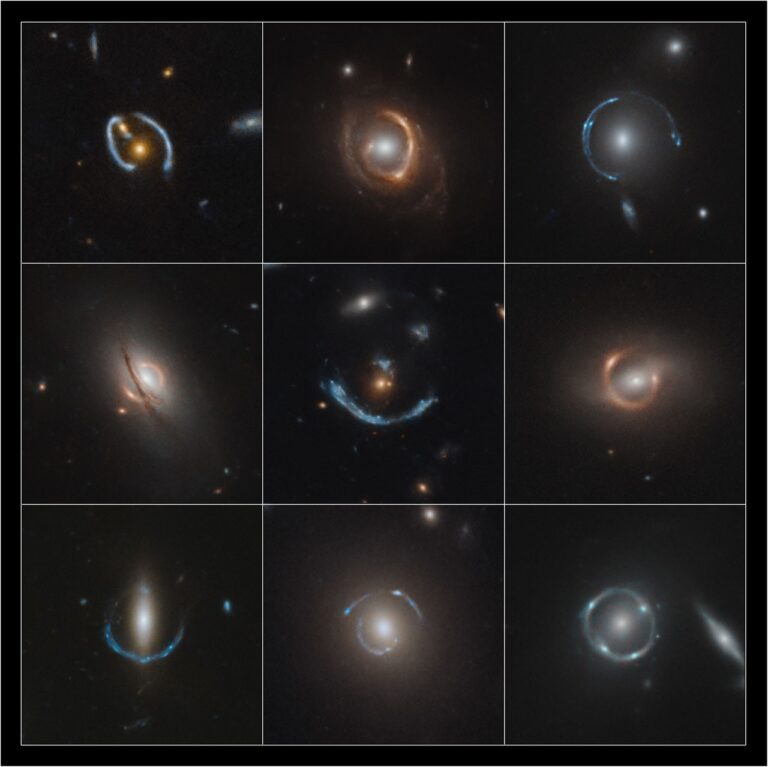
The images reveal how precise alignments between galaxies create distorted and magnified representations of background galaxies, which appear as arcs surrounding the foreground galaxies. Researchers plan to utilize the data from this diverse range of gravitational lenses to develop models that estimate the mass of the foreground galaxies. This effort may also provide insights into dark matter, as astronomers analyze the distortion of the background galaxies to assess the quantity and distribution of mass, including the elusive dark matter present in these systems.
Hubble primarily observes in visible and ultraviolet light, while Roman will focus on infrared and some visible wavelengths, allowing it to cover a far larger field of view. This complementary approach means that while Hubble excels in detailed observations of individual lenses, Roman can capture a broader array of lenses. If Roman identifies a particularly intriguing lens, further observations with Hubble’s capabilities may follow.
Collaboration Between Telescopes
As scientists investigate the gravitational lenses, they aim to identify small imperfections within the lensed arcs that could indicate the presence of minor dark matter clumps. Detecting these clumps could support the cold dark matter theory, which posits the existence of numerous small clumps of dark matter, ranging from one million to one billion solar masses. Meanwhile, the Milky Way’s dark matter halo is estimated to be around 1.3 trillion solar masses.
The images also serve a dual purpose, as they will help researchers create an advanced tool to efficiently search for similar arcs in future Roman observations. Hubble’s high-resolution data is expected to contribute valuable findings regarding dark matter while also facilitating the analysis of Roman’s larger dataset.
Diverse Features of Gravitational Lenses
The images depict several unique configurations of gravitational lenses. For instance, one panel features an arc-counterarc setup where the background galaxy appears as a pair of arcs due to the gravitational influence of two foreground galaxies. Another example is an Einstein Ring, formed when a galaxy’s alignment with a foreground lens creates a nearly complete circular image around the lensing galaxy. Different characteristics, such as the color variations in the lensed galaxies, provide clues about stellar ages, with blue arcs indicating younger stars and red arcs suggesting older ones.
Most foreground galaxies in these images are elliptical, known for their dense and compact structures. However, variations in the types of foreground galaxies can offer insights into their evolutionary histories. Some galaxies display spiral arms or visible dust lanes, showcasing the detailed observational power of Hubble.
Future Observations and Collaborative Efforts
The strong lenses showcased in these images were initially identified using The Dark Energy Spectroscopic Instrument at Kitt Peak and later observed by Hubble. The upcoming Roman Space Telescope will continue this exploration. The collaboration among NASA’s Great Observatories, including Hubble, the Chandra X-ray Observatory, and the James Webb Space Telescope, enhances our understanding of the universe. As Roman joins this collective effort, it opens up new avenues for cosmic discovery, aiming to expand humanity’s knowledge of the cosmos.
Source: NASA