Innovative Robotics Research at UNCW
Researchers at the University of North Carolina Wilmington (UNCW) are making strides in gaze-guided robotics, a technology that may enable individuals with limited mobility to control robotic assistants using their eyes. This initiative aims to enhance independence and improve the quality of life for those who cannot use their hands.
The project involves collaboration between students and faculty members, including Assistant Professor Hamed Saeidi and students Joseph Scott, Charlie Caputo, and Andrew Lawson. Together, they are developing a system that translates eye movements into commands for a robotic arm, utilizing eye-tracking technology to facilitate interaction for people with severe mobility impairments.
Addressing Challenges in Eye Movement Tracking
One significant challenge the research team faced was the natural, rapid movements of the eyes that can lead to erratic robotic motions. To counter this, they created an advanced controller capable of predicting eye movements in real time, which smooths out these sudden shifts. This innovation allows for more stable robotic control, making it easier for users to manipulate objects in their surroundings.
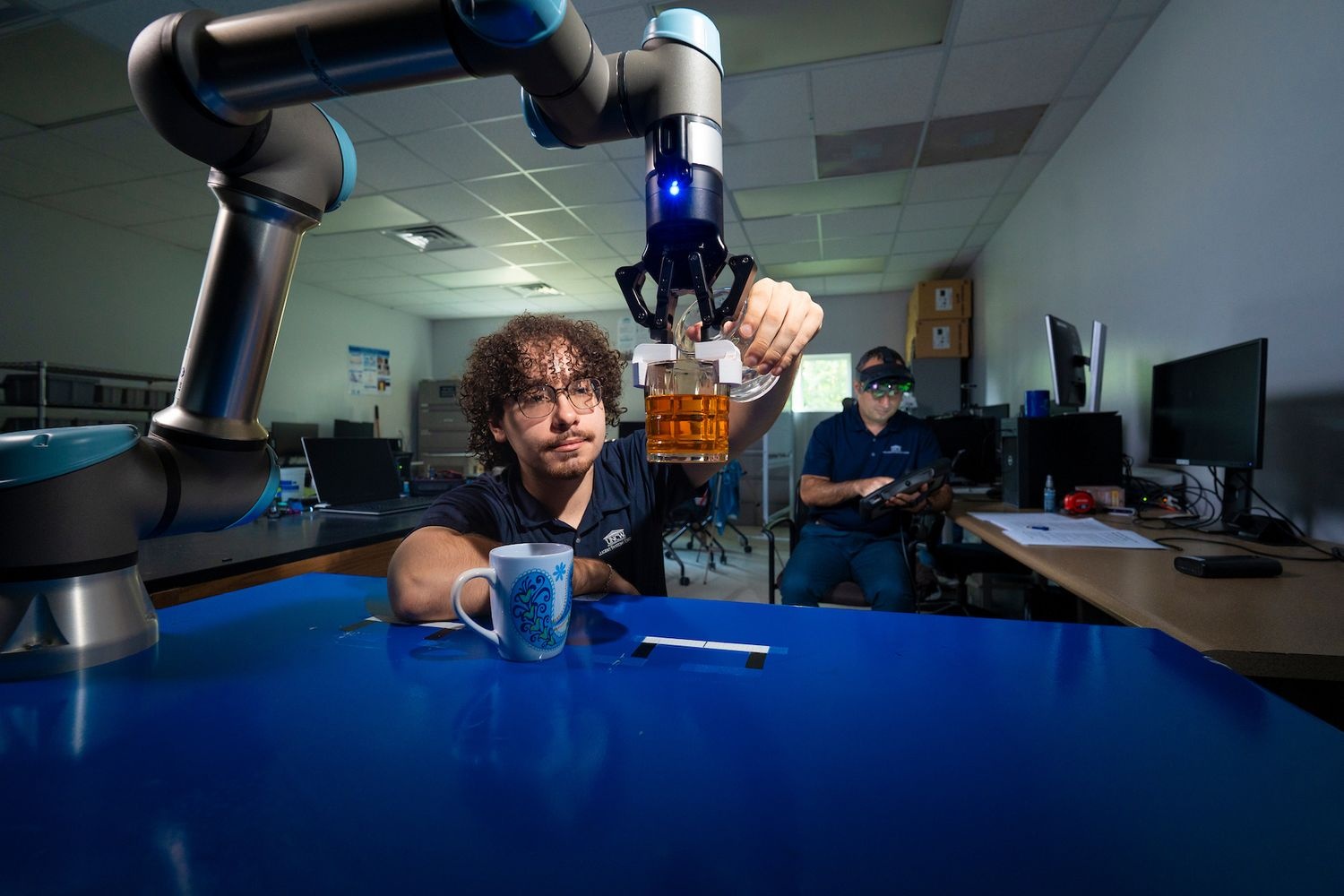
In their experiments, the team employed a Universal Robots robotic arm, equipped with smart glasses that track the user’s gaze, alongside voice command capabilities. They utilized several programming languages, primarily focusing on Model Predictive Control, which anticipates both robot and gaze movements to ensure responsive interaction.
Proving the Technology’s Effectiveness
To validate the functionality of their system, researchers successfully demonstrated the robotic arm’s ability to transport an open cup of liquid without spilling. Saeidi emphasized the importance of this achievement, stating that the ability to safely manage liquid with just eye movements indicates the system’s potential for aiding in everyday tasks, such as drinking or picking up objects.
Scott’s role included enhancing the user experience by fine-tuning the robot’s responsiveness to eye movements. Through rigorous testing with human participants, he adjusted parameters like speed and reaction time to align the robot’s movements with user expectations. He noted, “We tested three ways for users to move a robot arm using just their eye gaze and compared our new controllers to those from our earlier work.”
Future Prospects for Gaze-Guided Technology
The potential applications of gaze-guided technology are vast, according to Scott. He envisions its use in various contexts, including controlling humanoid robots, interpreting user intentions through eye movements, and integrating with prosthetic devices. He believes this technology could significantly enhance independence and accessibility in diverse environments.
For Scott, the motivation behind this project extends beyond technological advancement. He views engineering as a means to create positive change in the world and is driven by the desire to develop tools that facilitate everyday activities for individuals with disabilities. “Being able to make a positive change in the world with the skills I’ve learned is one of my biggest motivators,” he remarked, reflecting on how this project has reshaped his career aspirations and commitment to engineering as a vehicle for social good.
Source: UNC Wilmington