Bridging Medieval Studies and Data Science
Helen Davies has carved a unique niche at the intersection of medieval studies and data science, a combination that has defined her career. When she learned of a position that combined roles in the Department of English and the School of Data Science at UNC Charlotte, she felt it was the perfect fit for her interdisciplinary research approach.
Davies has spent the last twenty years merging various fields, such as Latin, anthropology, and digital humanities. Previously, at the University of Colorado Colorado Springs, she was an assistant professor of digital humanities, where she co-founded the UCCS Center for Research Frontiers in the Digital Humanities, aimed at fostering collaboration among scholars from diverse academic backgrounds.
“My work has never fit neatly into a single discipline, but it’s all driven by the belief that history deserves to be seen, preserved and protected,” said Davies.
Now, after a year at UNC Charlotte and receiving a Gambrell Faculty Fellowship to further study artificial intelligence and digital literacy in the region, Davies appreciates the supportive environment that encourages her multifaceted research.
Innovative Technology in Historical Research
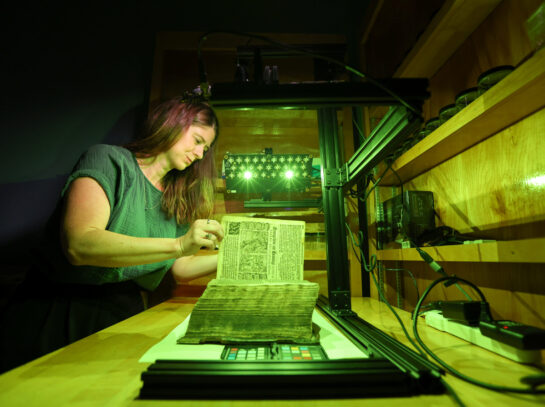
Davies employs multispectral imaging, a sophisticated technique that utilizes specialized cameras and light to reveal damaged or illegible text. While this technology has predominantly been used for ancient manuscripts, she is particularly interested in what she terms “everyman history”—the lesser-known documents and stories that are often neglected or damaged. She aims to make this imaging technology accessible and community-focused, allowing local historians to document important regional histories.
In one instance, while examining historical documents in Boulder, Davies successfully used her imaging system to recover names from manumission records, which had been scratched out. “That experience reinforced how important it is to help people recover histories that have been physically erased,” she remarked.
Interdisciplinary Teaching and Student Collaboration
Davies’ teaching portfolio includes courses in medieval literature and digital humanities, where she encourages students to integrate humanities and data science. “I would love for data science students to have more humanities exposure and for humanities students to understand more of the data side,” she explained.
This summer, she received a seed grant from the School of Data Science to create user-friendly software for processing multispectral imaging data. Collaborating with a data science Ph.D. student and a master’s student in English, she worked on finalizing the Python code for the imaging software, which enhances usability across various disciplines.
Aubrey Chapman, one of her students, noted that the project expanded her understanding of manuscripts and the technical aspects of imaging, deepening her interest in the field.
Empowering Communities Through Technology
Davies is committed to democratizing access to imaging technologies and digital methods for communities holding cultural heritage materials. She has developed a portable imaging kit, costing under $500, that can easily be transported and does not require specialized facilities. Her goal is to enable individuals to document and preserve their own historical materials without needing extensive training.
“I want anyone to be able to take one of these kits into whatever archive they’re digging around in, take pictures, press a button and get a set of processed images they can flip through,” Davies stated.
With support from a National Endowment for the Humanities grant, she is preparing to lead a summer institute aimed at training librarians and archivists to preserve materials damaged by various factors, equipping them with imaging kits for their own use.
Commitment to Medieval Studies
Despite her focus on community preservation, Davies remains deeply engaged in medieval studies. She recently traveled to Germany to utilize multispectral imaging on manuscripts that have undergone palimpsesting, revealing previously hidden texts.
Additionally, she is nearing the completion of a digital edition of the Vercelli Mappa Mundi, a significant medieval wall map. This work builds on her dissertation research and examines the educational and organizational roles of medieval maps.
Davies’ endeavors not only highlight the collaboration of data science and humanities but also illustrate the potential for uncovering valuable historical narratives and fostering new academic pathways. Chris Boyer, Dean of the College of Humanities & Earth and Social Sciences, emphasized the significance of her work in bridging diverse fields to generate impactful knowledge.
Source: UNC Charlotte