Spooky Artifacts on Display
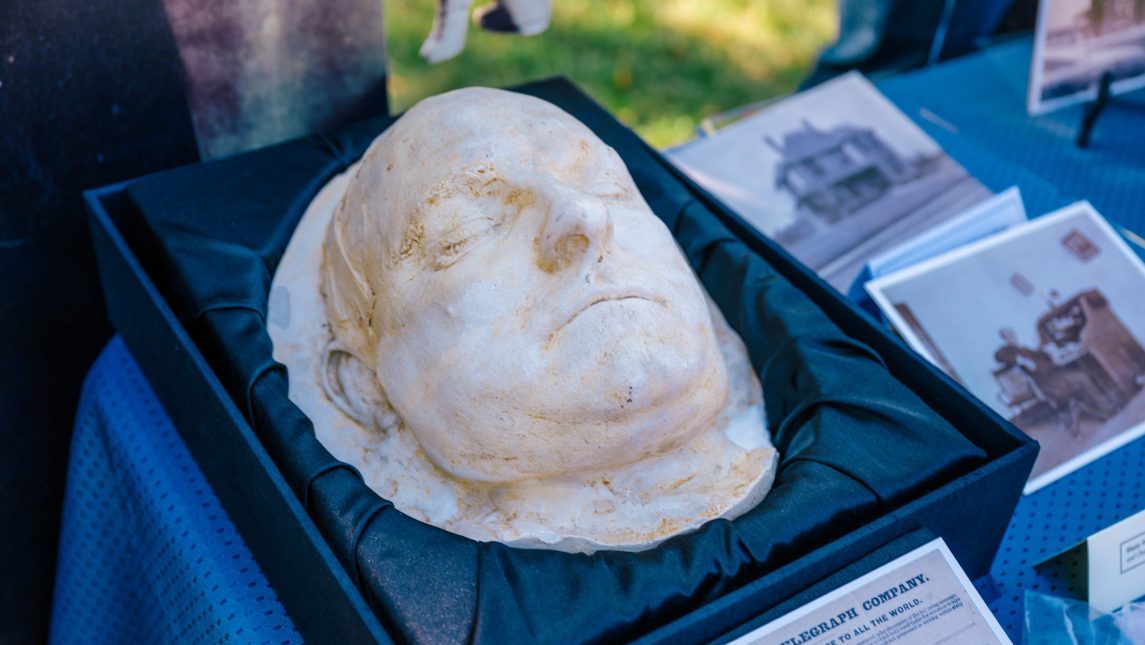
The Hodges Reading Room at the Main Library is showcasing an intriguing collection of eerie artifacts this week, including the death mask of Charles McIver, the founder and first president of what is now the University of North Carolina at Greensboro. This exhibit is part of the second annual “Hodges Halloween Hijinks,” an opportunity for the archives team to reveal some of the most haunting items from their collection.
Among the notable pieces is an 1832 edition of Mary Shelley’s “Frankenstein,” a novel she began writing at just 18 years old. The inspiration for this iconic tale emerged during a stormy gathering in 1816 at a villa near Lake Geneva, featuring literary figures like Percy Bysshe Shelley, Lord Byron, Claire Clairemont, and Dr. John Polidori. During the retreat, Byron prompted the group to craft ghost stories, leading to Shelley’s creation of “Frankenstein.” Dr. Polidori’s story, which would become “The Vampyre,” was also produced during this gathering, with an early edition featured in the exhibit. Other notable works include King James I’s “Daemonologie,” published in 1616, an 1899 American edition of “Dracula” by Bram Stoker, and ghost-themed writings by Sir Arthur Conan Doyle, who is primarily known for his Sherlock Holmes character.
Exploring Supernatural Interests
Kathelene Smith, associate professor and head of the Martha Blakeney Hodges Special Collections and University Archives, highlighted Doyle’s fascination with the supernatural, noting that his wife was a medium and that he was a committed spiritualist. The exhibit includes Doyle’s “The Case for Spirit Photography,” first published in 1922, and his two-volume “The History of Spiritualism,” released in 1926. “It was really an interesting aspect of his personality that he was writing these mysteries based on a character who was all about logic,” Smith remarked, “and then he was also very interested in all of these supernatural things.”
The exhibit will remain open until Halloween and features additional rare books and artifacts, including a set of papier-mâché Jack-o-lanterns crafted by the home economics department in 1930.
McIver’s Death Mask
Among the exhibit’s most chilling items is McIver’s death mask, created shortly after his passing in 1906 by Greensboro architect Wells L. Brewer. Sculptor Frederick W. Ruckstuhl later utilized the mask to produce McIver’s memorial statue, which has been situated at the College Avenue entrance of the Main Library since 1912. Ruckstuhl retained the mask until 1915, when he presented it to Edward K. Graham, the president of UNC-Chapel Hill. After years of display at the Peabody Educational Building, the mask was stored in the archives until 1962, when Charles M. Adams, the Woman’s College Librarian, retrieved it with McIver’s daughter, Lula, returning it to its rightful place.
Future of the Exhibit
While “Hodges Halloween Hijinks” will not return until next year, the University Libraries maintains a “ghost file” that catalogs all the intriguing and eerie artifacts related to UNCG’s extensive history. Additionally, students can schedule ghost tours on campus, exploring stories of spirits such as the Grey Lady of the UNCG Auditorium, the ghost of Clara Booth Byrd at the Marcus T. Johnson Alumni House, and other spectral figures linked to the Faculty Center, which stands on the site of the original infirmary that treated typhoid epidemic victims in 1899. Smith noted that interested individuals can arrange campus ghost tours through University Archives and Special Collections.
Source: UNC Greensboro