Stunning Nighttime Views from Space Station
Astronauts aboard the International Space Station (ISS) experience breathtaking vistas of Earth at night, comparable to the beauty of the cosmos. Donald Pettit, a NASA astronaut and avid photographer, described the view as “spectacular” in an essay featured in Air & Space magazine. He noted that cities appear as luminous tendrils, reminiscent of a Broadway marquee, while fishing boats illuminate dark waters, evoking a new constellation of stars.
Fellow astronaut Sally Ride, the first American woman in space, also expressed her awe at the sights from orbit. In her own essay for the magazine, she highlighted the extraordinary view of lightning from above the clouds. “On Earth, people see lightning from below the clouds. In orbit, we see it from above,” she explained, describing how lightning transforms into radiant bursts when viewed from space. “Sometimes, when a storm extends hundreds of miles, it looks like a transcontinental brigade is tossing fireworks from cloud to cloud,” she added.
Recent Observations Over the South China Sea
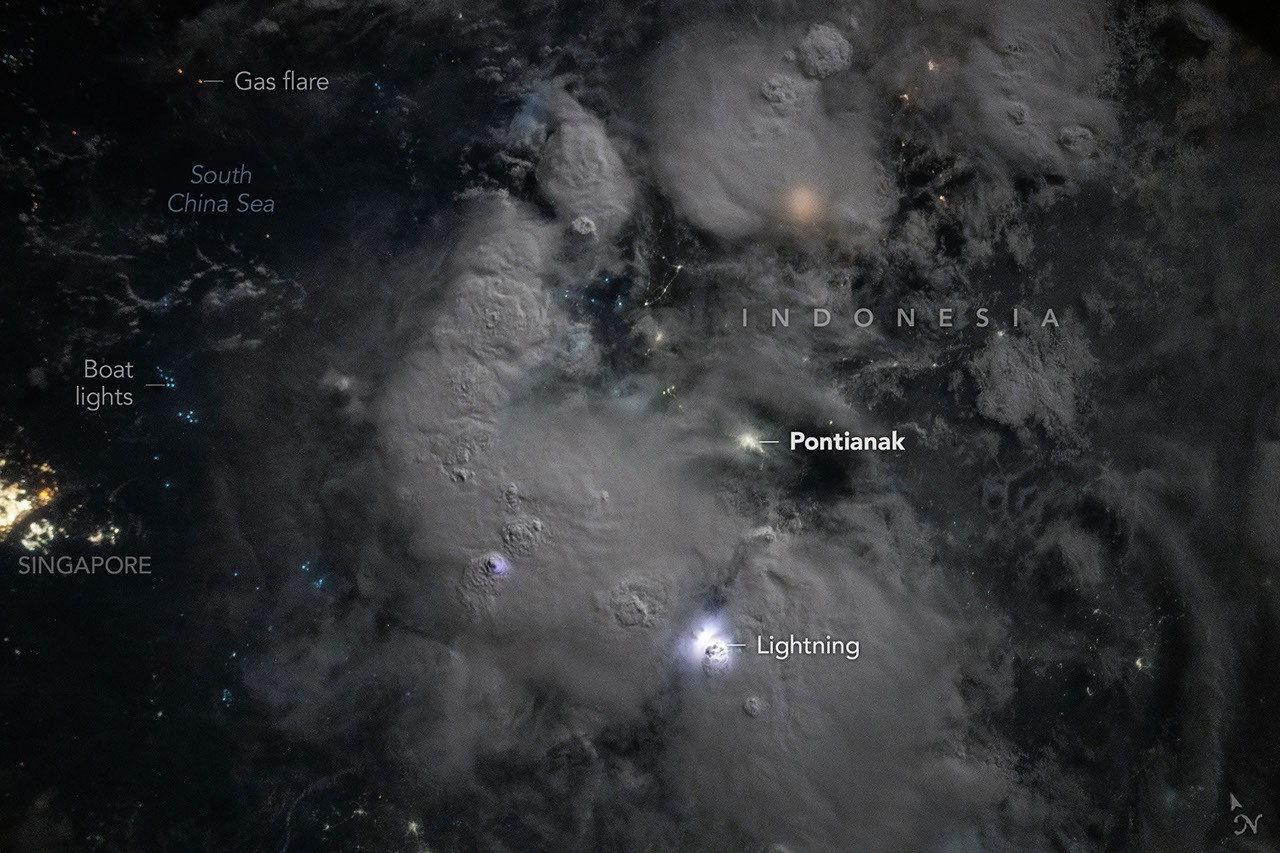
Both city lights and lightning were vividly displayed during an ISS flyover of the South China Sea near Borneo on October 28, 2026, at 14:20 UTC. An astronaut captured this striking scene using a Nikon Z9 camera. The photograph revealed towering thunderstorm clouds, some lit up by lightning strikes. These overshooting tops signify strong updrafts and intense storm activity.
The image shows the lights of Singapore, a city-state with a population of 6.2 million, on the left side, separated from the nearby Batam and Bintan islands by the Singapore Strait. A cluster of blue lights to the west of Singapore, resembling the Pleiades constellation, likely comes from fishing boats utilizing bright lights to attract squid and other schooling fish. Scattered orange points in the northwest are probably gas flares.
Astronauts’ Fascination with Lightning
For many astronauts, the sight of lightning is particularly memorable. Anil Menon, another NASA astronaut, referred to it as his favorite view from space, likening it to fireflies dancing in the night. He shared a video showcasing the flickering pinpoints of lightning along Earth’s horizon, emphasizing its beauty and the difficulty in capturing such moments. “It’s unchanged, at real speed, and shows the vast reach of storms and lightning across Earth,” Menon noted.
NASA estimates that at any given moment, approximately 2,000 thunderstorms are active worldwide, generating nearly 60 flashes of lightning every second, which totals around 5 million flashes daily.
Details of the Astronaut Photograph
The photograph, designated ISS075-E-250951, was taken on October 28, 2026, using a Nikon Z9 digital camera with a 14-millimeter focal length. It was processed to enhance contrast and remove lens artifacts. The ISS Program supports this initiative, allowing astronauts to take valuable images of Earth and make them publicly accessible. Additional photographs from astronauts and cosmonauts can be found through NASA’s resources.
Source: NASA