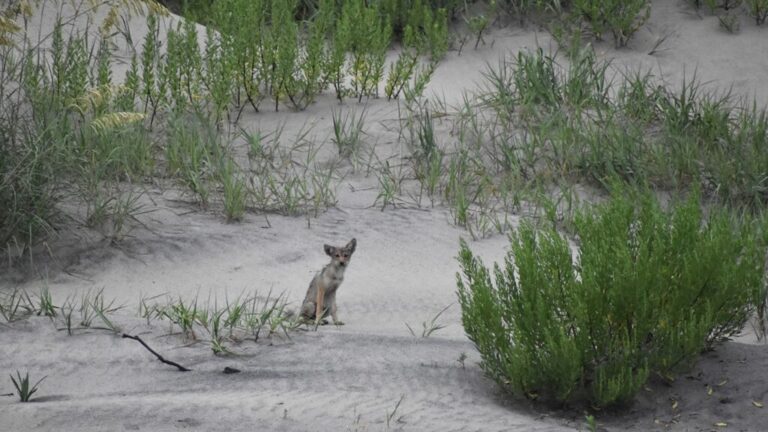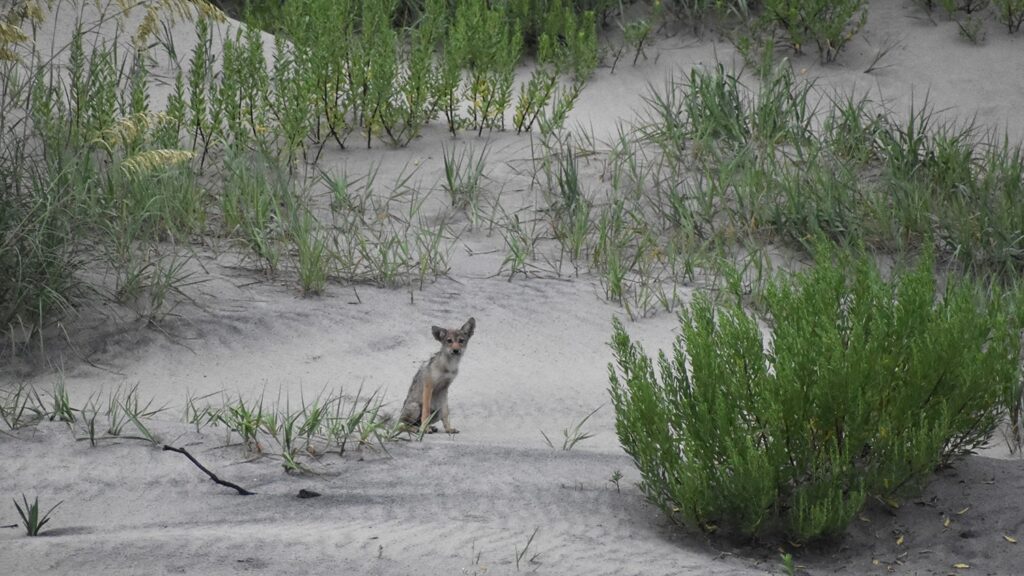
Coyote Populations Persist on Outer Banks
A recent study has found that coyote populations continue to thrive on the Outer Banks, despite ongoing removal initiatives aimed at protecting shore-nesting birds and sea turtles. This research marks the first comprehensive evaluation of coyote populations on barrier islands and provides insights into their ecological impacts.
Conducted by researchers from North Carolina State University, the study is the first peer-reviewed assessment to estimate coyote density and population size on any barrier island. Over three seasons from 2024 to 2025, the team analyzed DNA from coyote fecal samples collected across seven islands: Bodie, Pea, Hatteras, Ocracoke, North Core, South Core, and Shackleford Banks.
The researchers identified a total of 62 individual coyotes and estimated that the population fluctuates between 45 and 60 coyotes at any given time, despite removal efforts. In 2024, the National Park Service removed 14 coyotes from Bodie and Hatteras islands, yet monitoring showed persistent coyote presence throughout the year, indicating a significant turnover as new coyotes moved in to replace those removed.
Implications of Coyote Adaptability
Daniel Sossover, the study’s lead author and a research associate at NC State University, commented on the findings, stating, “Coyotes are here to stay on the Outer Banks.” He emphasized that the considerable investments made by the National Park Service over the past decade have not successfully reduced the coyote population, suggesting a need for a shift in management strategies.
Sossover pointed out that coyotes have expanded their range into the Outer Banks over the last twenty years, likely via bridges and swimming between islands. This expansion has raised concerns among residents and wildlife managers due to the potential threat to local wildlife.
Since 2009, the National Park Service and the U.S. Fish and Wildlife Service have removed more than 170 coyotes across various protected areas, including Cape Hatteras National Seashore and Pea Island National Wildlife Refuge. These areas serve as critical nesting habitats for shorebirds and sea turtles.
Sossover’s research indicates that efforts to control coyote populations through lethal removal may be largely ineffective due to factors such as increased reproduction rates in response to population pressure. Previous studies have shown that heavy removal can lead to earlier breeding and larger litter sizes among coyotes.
Genetic Diversity Among Coyote Groups
The study also revealed that coyote density generally decreases as islands become more isolated from the mainland. Bodie Island, which is connected to the mainland, exhibited the highest density of coyotes, while North Core Banks showed the lowest.
Researchers identified four distinct genetic groups among the coyotes on the Outer Banks, suggesting that these populations originated from a limited number of founders. The genetic analysis showed low diversity within these groups, indicating that many coyotes are closely related and likely descended from a small number of individuals introduced to the islands.
The researchers observed that on Bodie and Hatteras islands, coyotes formed separate packs that occupied different areas, while other islands supported a single pack that utilized the entire island. However, there were still genetic connections to mainland populations, highlighting the occasional immigration that helps sustain these island groups.
Sossover remarked on the “remarkable adaptability of coyotes,” noting that small founding groups can effectively establish and persist in new environments, even under removal efforts.
Future Management Strategies
The findings of this study may prompt a reevaluation of coyote management policies on the Outer Banks, where eradication seems unlikely to succeed. Instead, Sossover suggests that wildlife managers might need to adopt strategies that focus on mitigating the impact of coyotes on vulnerable nesting species, potentially incorporating behavioral deterrents alongside or instead of lethal removal.
The study titled “Coyote density, demography, and genetic structure across North Carolina’s barrier islands” has been published in the Journal of Wildlife Management. Co-authors include NC State University professors Roland Kays and Elizabeth Kierepka, along with Nathan Hostetter from the U.S. Geological Survey. This research was supported by the National Park Service Inventory and Monitoring Division.
Source: NC State University