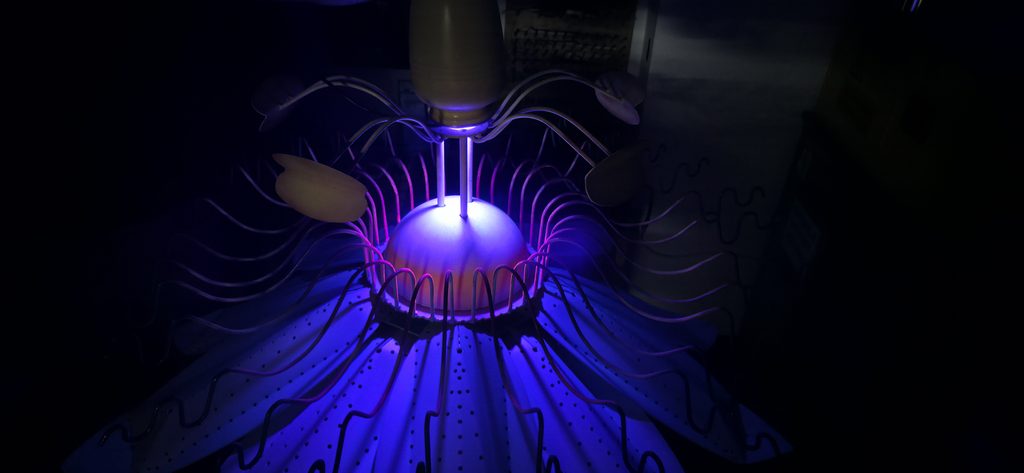
A striking sculpture named Bee Vision has been unveiled at the Court of North Carolina, where a metallic flower, crowned with a column of ceramic clay, catches the light during the day. As night falls, a UV lamp illuminates the piece, revealing a bull’s-eye pattern that is invisible to the human eye but guides bees toward nectar.
Constructed by a collaborative effort involving students, faculty, and staff from the Natural Learning Initiative (NLI), the Materials Lab, and the Digital Clay Lab, along with contributions from the Crafts Center and C:Lab, the sculpture aims to educate visitors about pollinator vision and provide nesting sites for solitary bees.
Inspiration from Nature
The concept for Bee Vision originated from Shep Byles, who developed a summer camp program focused on bees while working as an environmental educator at Haw River State Park. Byles, now a Master of Landscape Architecture and Environmental Planning student, was inspired by the UV nectar guides that many flowers possess, which are visible only to bees.
Upon receiving a grant opportunity from NLI co-founder Nilda Cosco, Byles quickly shared his vision for the sculpture. Although he could not lead the grant application due to his student status, Cosco took on the role of principal investigator, with Robin Moore serving as co-PI. The proposal was submitted in December 2025, paving the way for the project.
Creating the Sculpture
The team chose to create a purple passionflower (Passiflora incarnata), a native plant of North Carolina, due to its distinctive features that are easily recognizable. Its corona, adorned with a bull’s-eye pattern, is designed to attract bees, and the UV-reactive paint used allows people to see what the flower looks like to pollinators.
Bee Vision consists of approximately 20 ceramic pieces, including wave-textured column tiles and removable “bee blocks” designed for nesting. The pieces were created using a clay 3D printer and modeled in Rhino software, with the choice of local clay emphasizing the sculpture’s connection to its environment. The ceramic remains unglazed to maintain its natural appearance.
Collaborative Design Process
Throughout the project, the design process remained fluid, adapting to the challenges of working with different materials. The team experimented with various colors and coatings to ensure the sculpture was both visually appealing and functional. Adjustments were made based on the behavior of the materials during production, particularly in terms of how the clay and metal responded during fabrication.
With the help of NC State’s Facilities Division, the team installed a UV lamp to enhance the sculpture’s visibility and functionality. Two signs located near the installation include QR codes linking to additional information about the project and its scientific background.
A Living Research Project
Bee Vision serves not only as an art installation but also as a research tool. The twelve bee blocks are part of an experiment to determine whether bees will nest in various materials, including blue oyster mycelium and a mixture of clay and straw. The results of this research will contribute to a better understanding of bee behavior and habitat preferences.
The team plans to open the blocks for inspection in the spring, alongside community events focused on bee conservation. Byles emphasizes the importance of stewardship for the project, which aims to foster a deeper connection between people and nature.
Future of the Installation
Initially approved as a temporary installation, discussions are underway to make Bee Vision a permanent fixture on campus. NC State’s Facilities Division has recognized the success of the pollinator planting associated with the sculpture, prompting interest in similar initiatives across the university grounds.
As Byles continues to study the project, he hopes to explore how art can enhance awareness and appreciation for pollinator habitats. For Cosco and Moore, the sculpture represents a larger vision of encouraging curiosity and engagement with the natural world, suggesting that it will inspire future projects and research endeavors.
Source: NC State University