Global Vegetation Color Changes Observed
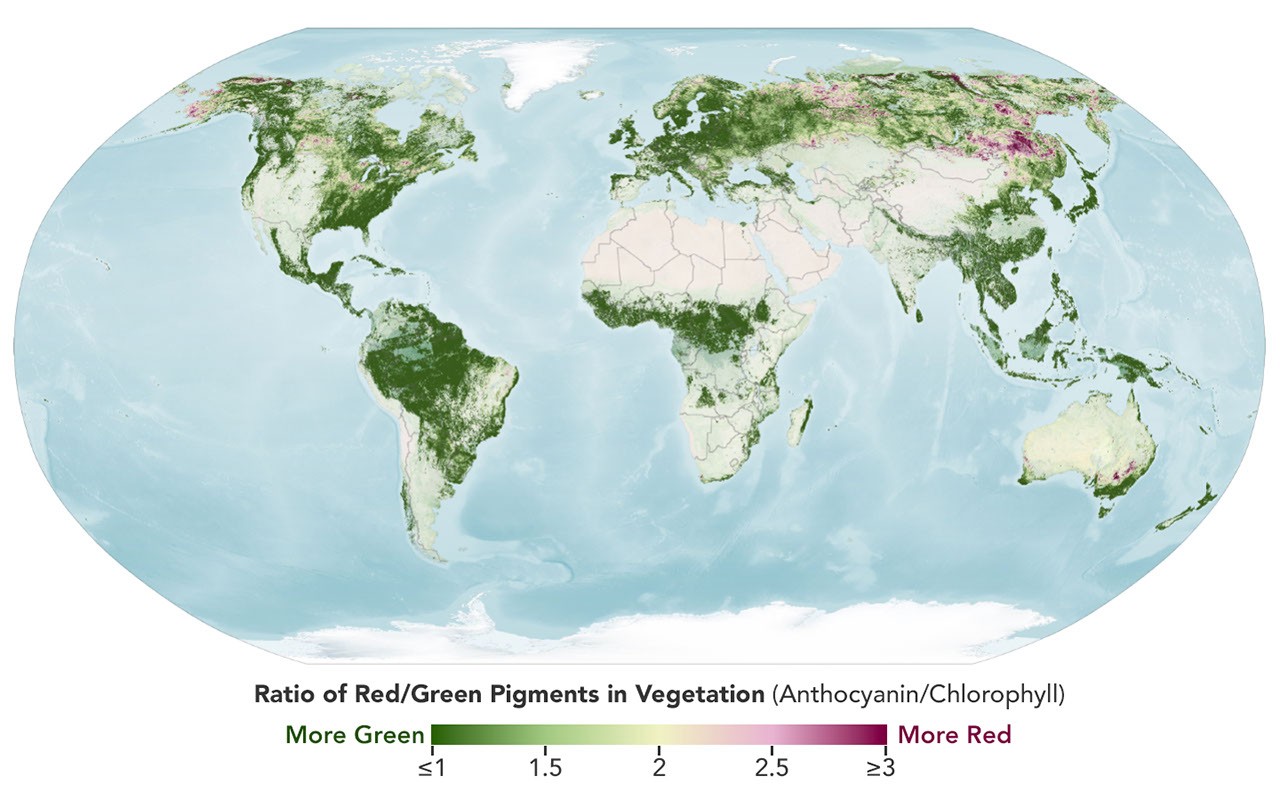
NASA’s Earth Observatory has released new maps illustrating the changing colors of vegetation across the globe from September 29 to October 11, 2026. These maps, created using data from the Ocean Color Instrument (OCI) on the PACE satellite, showcase a spectrum of colors ranging from deep green to bright red, indicating the presence of fall foliage.
During the period from September 29 to October 4, significant patches of red vegetation were noted primarily in regions such as Alaska, northern Canada, Mongolia, and parts of Russia. Conversely, smaller areas displaying red hues were also identified in Australia. By the following week, from October 5 to 11, the most vibrant red areas shifted southward, becoming more prominent in the Mid-Atlantic and Southeast United States, as well as southern Russia, China, and Mongolia.
Tracking Fall Foliage with Satellite Technology
The OCI on NASA’s PACE satellite monitors daily changes in the Earth’s vegetation, analyzing 286 spectral bands to track alterations in leaf pigments that contribute to autumn colors. This process allows scientists to determine the peak times for color changes by comparing the ratios of red, orange, and yellow pigments against green.
The readings indicate that from September 29 to October 4, the highest levels of red were observed in northern and eastern Russia, northern Alaska, and northern Canada. As the season progressed into early October, New England and upstate New York saw a decline in red foliage, while the Midwest and Mid-Atlantic regions began to exhibit more pronounced red hues.
Notably, the maps also reflect the impact of agricultural practices, as some crops may display elevated anthocyanin levels due to aging or harvest processes, leading to misleading representations of autumn foliage.
Significant Regions for Fall Foliage
Key areas known for their striking fall colors include the Adirondacks in New York, the Green Mountains in Vermont, and the White Mountains in New Hampshire, where species such as sugar maples and red maples contribute to the vivid reds observed. The satellite imagery captured on October 3, 2026, highlights the rich reds around Ripton, Vermont, a location historically associated with poet Robert Frost.
While other satellites have similar capabilities to measure changes in foliage pigments, PACE stands out as the first satellite to consistently measure all three major leaf pigments—anthocyanins, carotenoids, and chlorophylls—globally every few days.
Public Participation in Foliage Observation
As part of the North American Phenology Campaign, NASA data scientist Skye Caplan has been actively sharing weekly updates on vegetation colors. These updates track the progression of fall colors across different latitudes and encourage public involvement through the submission of ground-level foliage photographs. Such contributions are invaluable for validating satellite data and understanding the factors influencing plant coloration.
Caplan emphasizes the need for diverse observations, stating that scientists are interested in images of all types of vegetation, including shrubs, grasses, and crops, beyond just traditional fall foliage. She cautions that the vibrant changes in color can be fleeting, urging participants to capture the moment as it occurs.
NASA Earth Observatory images by Lauren Dauphin, utilizing data from PACE and other sources, underscore the significance of ongoing research in understanding the dynamic nature of vegetation and its broader ecological implications.
Source: NASA