Voyager Mission Overview
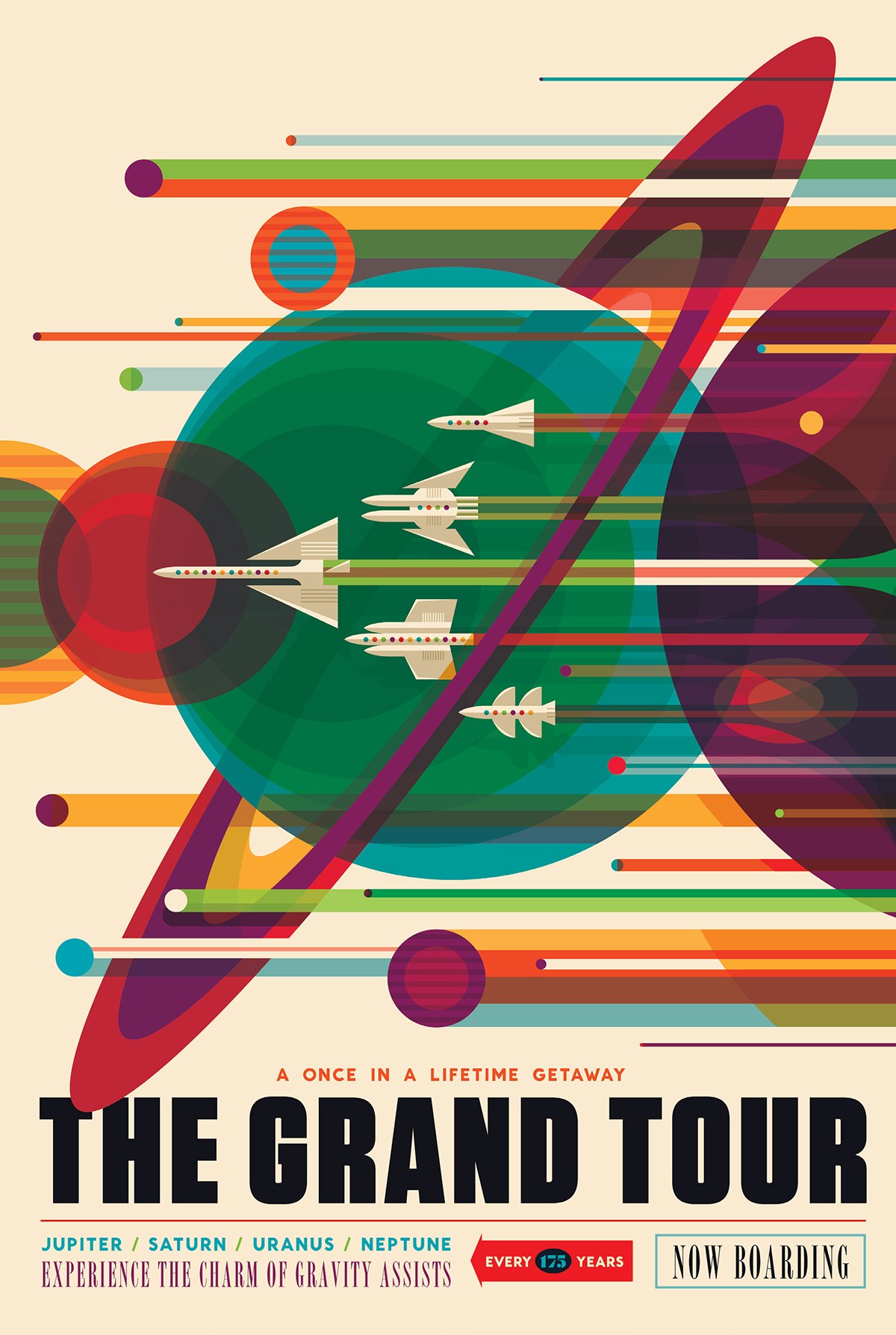
NASA’s Voyager mission is celebrating its remarkable journey through the solar system, having capitalized on a rare alignment of the outer planets that occurs once every 175 years. Launched in 1977, the twin spacecraft, Voyager 1 and Voyager 2, utilized gravitational assists from Jupiter, Saturn, Uranus, and Neptune, enabling detailed exploration of these gas and ice giants. This Grand Tour not only provided unprecedented insights into these planets but also laid the groundwork for future missions such as Galileo and Cassini. Both Voyager probes continue to send valuable scientific data from beyond the solar system.
Significant Discoveries
During their travels, the Voyager spacecraft captured stunning images and information about the four largest planets and their moons. By the 1980s, Voyager 2 had ventured towards Uranus and Neptune, while Voyager 1 took one final snapshot of Earth before continuing its journey. This iconic image of Earth, often referred to as the “Pale Blue Dot,” emphasizes our planet’s smallness within the vast universe.
The Golden Record
Each Voyager spacecraft is equipped with the Golden Record, a 12-inch phonograph that serves as a time capsule of human culture. The record contains greetings in 55 languages, a diverse selection of 27 musical tracks, 116 images depicting life on Earth, and various natural sounds. It is protected by a cover that illustrates the Sun’s position relative to 14 pulsars and includes instructions for playback. The record and its cover are designed to withstand the harsh conditions of space, incorporating materials like copper, gold plating, and aluminum, along with uranium-238, an isotope with a half-life of 4.468 billion years.
Current Status and Future Milestones
In terms of distance, a light-minute is a unit of measurement for space rather than a measure of time. Both Voyager 1 and Voyager 2 crossed the heliopause—the boundary where solar wind from the Sun meets the interstellar medium—during their journeys in August 2012 and November 2018, respectively. As of this report, the Canberra antenna is tracking Voyager 1, which is currently approximately 25.80 billion kilometers (over 16 billion miles) away from Earth.
On November 18, 2026, Voyager 1 is projected to cross the one-light-day mark, reaching a distance of 16.1 billion miles from the Sun. This milestone highlights the vast distances involved in space exploration. The differences in distances within our solar system can be illustrated through light measurements, providing a better understanding of our cosmic neighborhood. Activities such as the Gravity Assist and Measuring a Kid Minute guides offer engaging ways to explore these concepts further.
Source: NASA