NASA’s LISA Mission to Uncover Hidden Exoplanets
NASA is making strides in its efforts to explore new worlds beyond our solar system through the development of the Laser Interferometer Space Antenna (LISA). Two recent studies by NASA astrophysicists reveal how this observatory could detect a previously unseen population of exoplanets throughout the Milky Way galaxy.
LISA is designed to identify gravitational waves—minute ripples in space-time created by the movement of massive objects in orbit. The research highlights how the presence of a planet can alter the gravitational wave signals emitted by double white dwarf systems, allowing scientists to detect planets as massive as Jupiter from thousands of light-years away.
Research Insights on Gravitational Waves
The findings were published in two papers in The Astrophysical Journal. The first paper, authored solely by postdoctoral researcher Casey McGrath, focuses on the methodology for detecting these planets, outlining the optimal planet masses and orbital periods for successful identification. The second paper, co-authored by McGrath and others, discusses how these planets could be confirmed using NASA’s James Webb Space Telescope.
This concept of detecting exoplanets in binary white dwarf systems was originally proposed in 2008 by Japanese astronomer Naoki Seto. The LISA mission, led by the European Space Agency, is anticipated to launch in the mid-2030s, with NASA contributing vital hardware and scientific expertise.
Understanding the Detection Mechanism
LISA’s detection method is akin to the radial velocity technique, which uses light to identify exoplanets around nearby stars. As a planet orbits a star, its gravitational pull induces a slight wobble in the star, shifting its spectral lines due to the Doppler effect. Scott Noble, a theoretical astrophysicist at NASA Goddard, explained that a similar effect occurs with gravitational waves. The presence of a planet introduces a modulation to the gravitational signal, producing sidebands—secondary signals at different frequencies.
McGrath compared this phenomenon to modern radio transmissions, where sidebands can carry additional information alongside the main frequency. For gravitational waves, these sidebands can indicate the presence of a planet.
New Discoveries on Exoplanet Populations
White dwarfs are the remnants of stars similar to the Sun, and while some exoplanets have been detected around isolated white dwarfs, none have been found in double white dwarf systems. The research indicates that LISA could represent a groundbreaking opportunity to identify a new class of exoplanets.
Astronomers estimate that there are around 10 million double white dwarf systems in the Milky Way with orbital periods under an hour, producing gravitational waves detectable by LISA. The mission is expected to resolve approximately 10,000 of these systems, including around 100 mixed binaries with other stellar remnants.
Confirmation of Exoplanets with James Webb
Once LISA identifies its first exoplanets, validation will be crucial. Mary Anne Limbach, a co-author on the confirmation paper, emphasized the importance of corroborating gravitational signals to confirm the existence of these planets. The team proposes utilizing the infrared capabilities of the James Webb Space Telescope, which can detect excess infrared light emitted by planets in double white dwarf systems, establishing their presence.
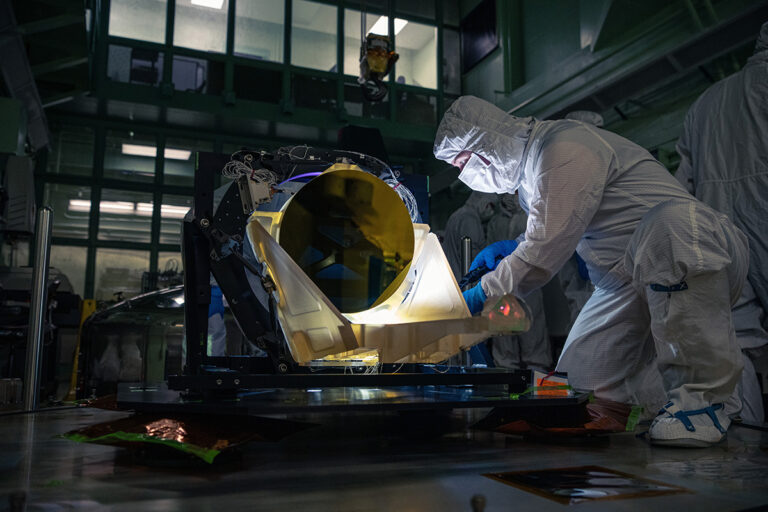
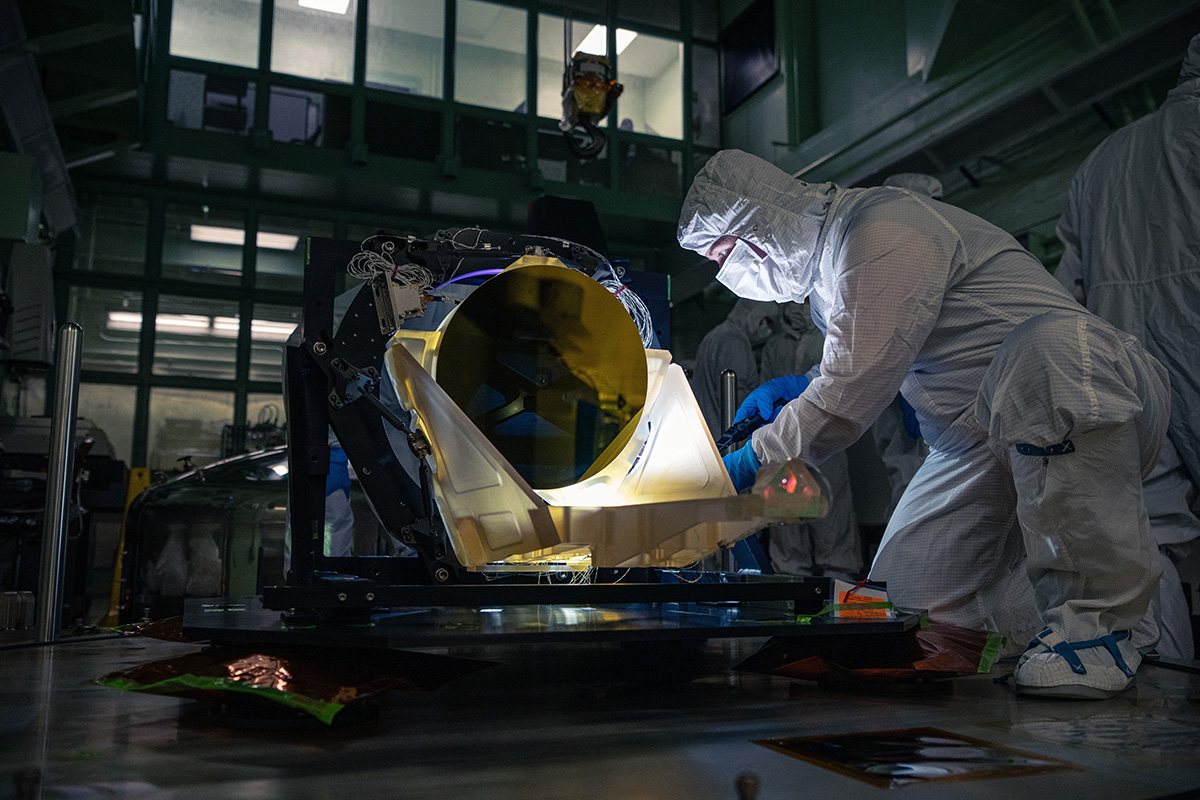
The LISA observatory will deploy three spacecraft in a triangular formation, spanning 1.6 million miles. Each spacecraft will be equipped with telescopes that utilize infrared laser beams to measure minute changes in their distances caused by passing gravitational waves.
The concept of gravitational waves, predicted by Einstein in 1916, was first detected in 2015. These waves, created by the acceleration of massive objects, offer a unique avenue for exploring the universe, unaffected by other materials in space.
NASA’s contributions to the LISA mission encompass systems for laser generation, electric charge management for proof masses, and data analysis for identifying gravitational wave sources.
Source: NASA