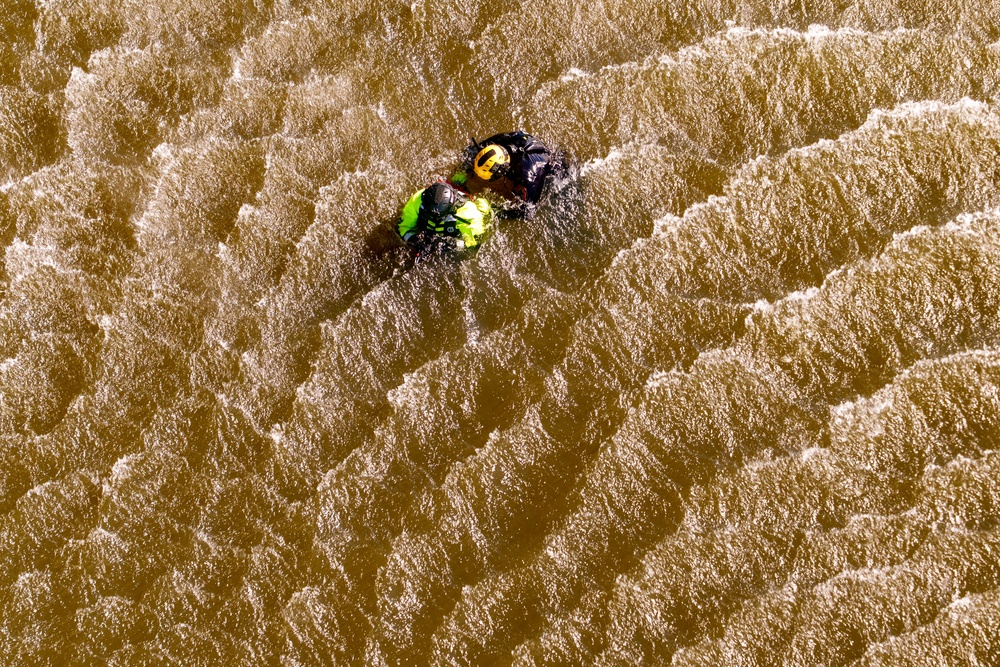
NEW LONDON, N.C. — A North Carolina National Guard UH-60M Black Hawk helicopter hovered over Badin Lake, sending rotor wash cascading over the water as a rescue technician descended via a steel hoist cable. While the operation appeared seamless from the shore, getting four helicopters ready for the training involved an intensive 48-hour maintenance effort in Salisbury.
During a multiday training exercise on October 21-22, 2026, at Stanly County Airport and Badin Lake, aircrews from Charlie Company, 1st Battalion, 131st Aviation Regiment, and Detachment 2, Charlie Company, 1st Battalion, 126th Aviation Regiment collaborated with the North Carolina State Highway Patrol and rescue personnel from both Charlotte and Durham fire departments. They focused on executing complex over-water hoist extractions.
The North Carolina Helicopter Aquatic Rescue Team (NCHART) initiative, coordinated through North Carolina Emergency Management, integrates military and state aviation resources with local rescue teams. Crucial to this operation is the NCNG’s maintenance workforce, which, along with a newly acquired fleet of UH-60M Black Hawks, provides essential support during emergency situations.
The efficiency of the NCNG’s maintenance capabilities was demonstrated just before the helicopters took to the skies for training.
“On Monday, we had zero mission-capable aircraft, and in 48 hours we went from zero to three,” said U.S. Army Capt. Jacob Knox, who leads Charlie Company. He noted that a fourth helicopter was also prepared in that timeframe, underscoring the critical role of the maintenance team. “Without that technician workforce, we simply cannot provide that response posture.”
By combining full-time federal aviation mechanics with traditional Guard members on additional flight training, the Salisbury maintenance group was able to restore all four helicopters to operational status in time for the launch.
Unique Maintenance Protocols in Military Aviation
This rapid recovery highlights the differences between military and civilian aviation maintenance, where civilian operations typically follow regular shifts and can utilize ground transport if an aircraft is out of service.
“With a civilian aircraft, if it went down for maintenance, it would just be down for maintenance,” said U.S. Army Chief Warrant Officer 3 Dustin Huffstetler. He compared this to military operations, where aircraft availability is paramount. “We don’t have an alternate. We are the primary plan for a lot of these missions.”
The camaraderie and shared responsibilities among the maintenance crews and pilots contribute to the operational culture. Mechanics often take on dual roles, being involved in both the maintenance and the actual mission operations. During the training, pilots like Huffstetler and Knox flew with crew members who had previously worked on the same helicopters.
“The culture itself is fundamentally different because a lot of times the mechanics working on these aircraft are the guys in the back,” Knox said. “Staff Sgt. Ingle has the vested interest of being involved in what’s happening on the preparatory side, knowing that he’s going to be in the back of that aircraft actually doing that mission.”
The consolidation of maintenance and logistics at the home base also proved advantageous during Hurricane Helene, allowing crews to respond quickly to emergencies.
“The technicians that weren’t flying had the ability to perform major maintenance functions on a 24-hour cycle, for the most part, so we could continue operations daily,” said U.S. Army Chief Warrant Officer 4 Bruce Scharbius, highlighting the logistical advantages during critical missions.
Technological Advancements Enhance Operations
The recent training exercise at Badin Lake also showcased significant technological advancements in the NCNG’s fleet. The transition from the older UH-60L helicopters to the newer UH-60M models has introduced sophisticated flight management systems that enhance operational efficiency.
During previous emergencies, pilots flying the legacy models relied on manual control and verbal communication to maintain stability during rescues. “With the Lima, you’re physically flying the aircraft,” Scharbius explained. In contrast, the Mike models now utilize digital systems that greatly alleviate pilot workload, allowing for longer and more precise operations.
The integrated flight controls of the UH-60M provide stability that is crucial during over-water missions, where rotor downwash can complicate rescues. This technological edge helps to maintain safety and reduce fatigue for pilots engaged in prolonged missions.
“The automatic flight control system with the new integrated flight director and coupled flight modes exponentially reduces the pilot workload,” Knox said. “Whereas before you’re fighting with the aircraft for eight hours straight, now we’re able to use the autopilot in flight modes.”
Interagency Collaboration for Effective Emergency Response
Throughout the training, the NCNG helicopters worked in conjunction with a North Carolina State Highway Patrol Bell 429, illustrating the effective collaboration between state and military aviation resources. A representative from North Carolina Emergency Management oversaw mission coordination, ensuring that the most suitable aircraft was deployed for each operation.
“You’re not going to bring a hammer to install a screw — you’re going to bring a screwdriver,” Knox stated, emphasizing the importance of selecting the right aircraft for specific rescue missions.
Once the appropriate aircraft is deployed, successful extractions rely heavily on the training and trust developed between helicopter operators and civilian rescue teams.
“The training that we do quarterly is imperative,” Scharbius said, noting the significance of practice in ensuring safety and effectiveness during real-world missions. The ongoing training cultivates the necessary skills and familiarity required to execute operations successfully when the stakes are high.
Source: North Carolina National Guard via DVIDS