Hubble and Webb Capture Cat’s Head Nebula
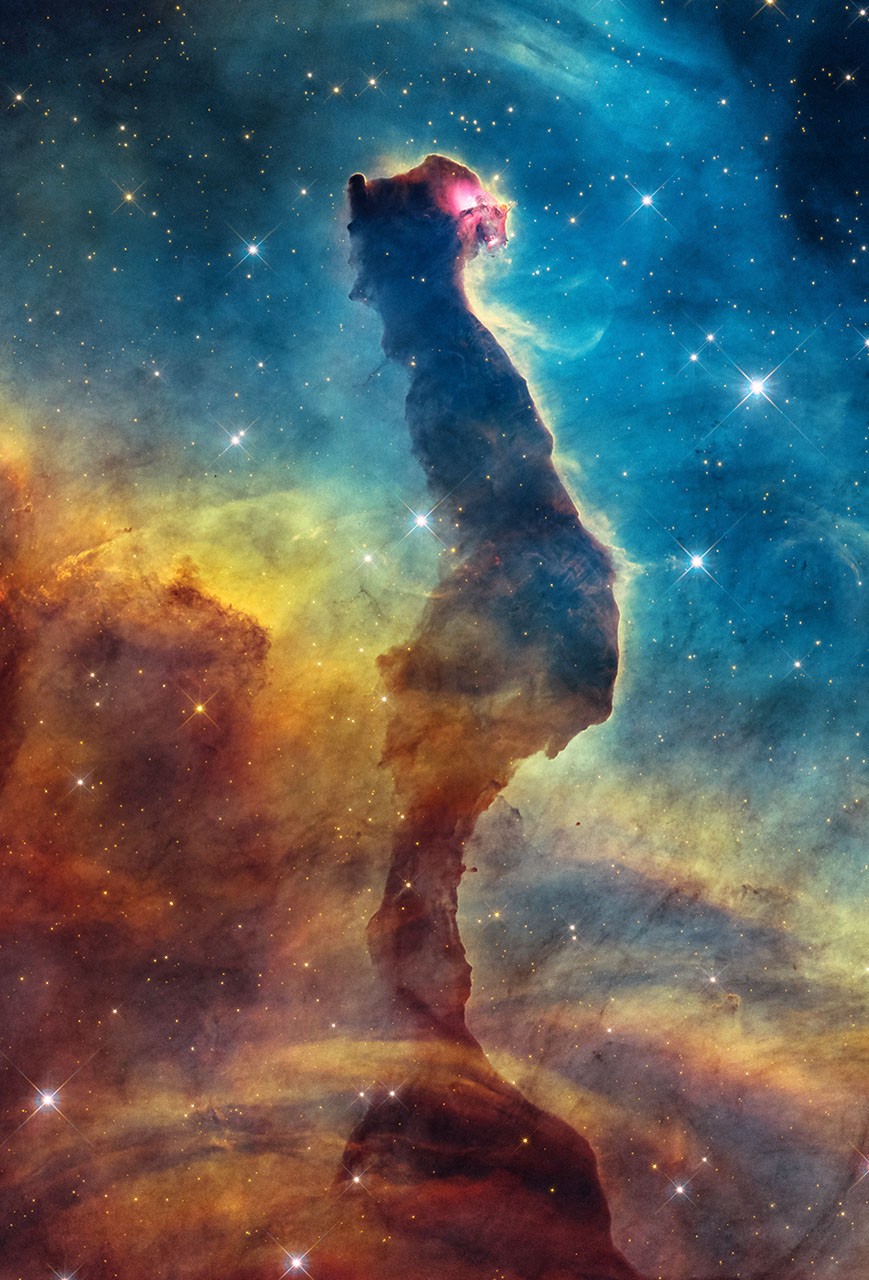
NASA’s Hubble Space Telescope, along with the James Webb Space Telescope, has unveiled a striking view of the Cat’s Head Nebula, located approximately 7,500 light-years from Earth within the Carina Nebula. This star-forming region is aptly named for its resemblance to a cat with its back turned, showcasing a luminous “eye” that likely signifies a young star shrouded in dust.
The observed nebula features an opaque dust pillar outlined by a bright rim of gas, with surrounding areas glowing in shades of blue due to emissions from ionized gases and scattered starlight. This dynamic region is a temporary formation that will eventually disperse as stars develop and evolve, providing astronomers with valuable insights into the intricate processes of star formation.
Insights from Hubble’s Observations
In its visible-light observations, Hubble captures a dark brown dust pillar, with the nebula’s “eye” glowing red, indicating a young star still buried in dust. A hazy yellow ridge runs along the right edge of the filament, consistent with gas illuminated by ultraviolet radiation from nearby massive stars, which may be driving the process of photoevaporation.
The surrounding material exhibits a spectrum of colors, ranging from blue and cyan at the top to yellow, orange, and red at the bottom. Hubble’s filters allow it to detect light emitted by oxygen, hydrogen, and sulfur, as well as starlight that is scattered by the dust, revealing a complex interplay of gas, dust, and stellar light.
James Webb’s Infrared Perspective
The James Webb Space Telescope enhances the view with its near- and mid-infrared capabilities, offering a deeper look into the nebula’s structure. In near-infrared light, Webb reveals detailed surface features of the dust pillar and a multitude of stars, many of which remain partially obscured by dust. The prominent yellow “eye” in this view likely indicates a young star embedded within the dust.
Webb’s mid-infrared images further illuminate the intricate structures within the nebula, highlighting emissions from warm dust and carbon molecules excited by starlight. Variations in color and brightness reflect changing local conditions, while delicate wisps of gas and dust are observable in this spectral range.
Collaborative Efforts and Ongoing Discoveries
Both telescopes provide complementary perspectives that enrich our understanding of star formation in this captivating region. Over its more than three-decade mission, Hubble has made significant contributions to astrophysics, functioning as a collaborative project between NASA and the European Space Agency. The Goddard Space Flight Center manages the telescope’s operations, while the Space Telescope Science Institute oversees Hubble’s scientific endeavors.
Meanwhile, the James Webb Space Telescope continues to unravel mysteries across the universe, examining distant worlds and the origins of cosmic structures. This international effort includes contributions from NASA, ESA, and the Canadian Space Agency, showcasing the collaborative spirit of modern astrophysics.
Source: NASA