New Initiative to Enhance Critical Thinking in Colleges
The College of Humanities and Social Sciences at North Carolina State University, in collaboration with the University of Notre Dame’s Institute for Social Concerns, is launching a significant initiative aimed at transforming the instruction of critical thinking across U.S. colleges. The program, known as Integrating Civil Discourse into the Curriculum (ICDC), has received a $4 million grant from the U.S. Department of Education to develop research-based tools that promote sound reasoning and civil discussion among students.
Over the next three years, ICDC will involve 375 faculty members from more than 125 institutions, impacting around 70,000 students. This initiative is characterized as a pioneering experiment designed to enhance civil discourse, enabling students to formulate and responsibly test their arguments during discussions.
Innovative Approaches to Teaching
Gary Comstock, a distinguished faculty member in philosophy at CHASS, oversees the ICDC project, while Suzanne Shanahan, director of the Institute for Social Concerns at Notre Dame, serves as the principal investigator. Their collaborative efforts include partnerships with various educational and nonprofit organizations across the nation.
The ICDC program incorporates three online platforms: Thinker, which focuses on imparting critical thinking skills; Sway, a tool that facilitates interactions between students with opposing views; and the Critical Reasoning and Inference Test (CRIT), which assesses students’ comprehension of argumentative essays.
Thinker employs mastery learning and argument mapping techniques to progressively enhance students’ reasoning abilities. Meanwhile, Sway pairs students with peers who hold contrasting opinions, encouraging thoughtful expression and respectful engagement. CRIT evaluates a student’s understanding of an argument’s main claim, supporting reasons, counterarguments, and responses to objections.
A Groundbreaking Educational Model
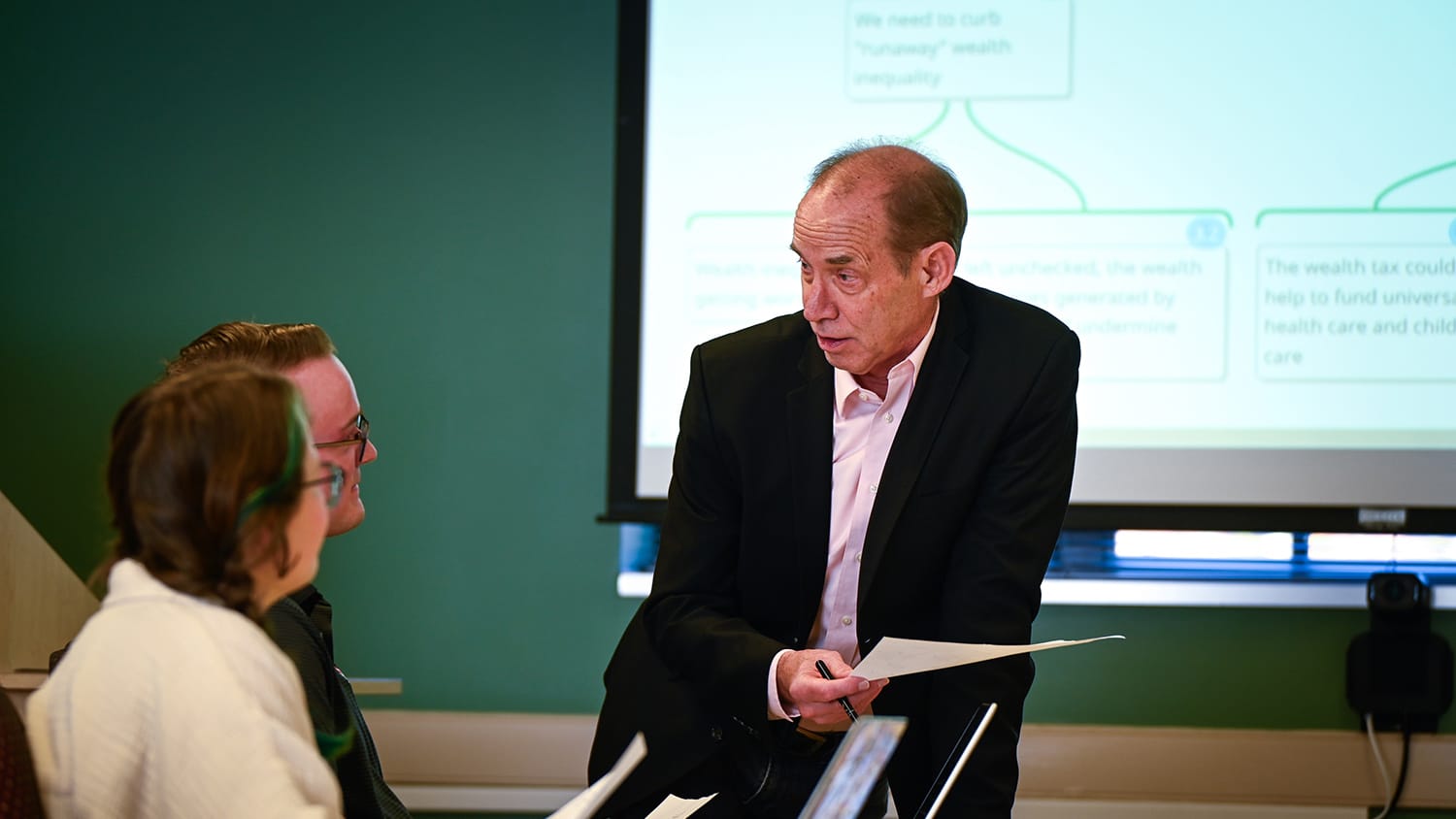
ICDC represents a novel approach by merging the teaching of critical thinking with civil discourse. Comstock emphasized, “To speak in a civil way, one must know how to reason in a fair way.” He noted that merely teaching the rules of debate is inadequate; students also need to differentiate sound arguments from flawed ones and practice these skills in real discussions.
The initiative seeks to engage nearly 100,000 students from diverse academic backgrounds, aiming to determine whether structured dialogue and argument mapping can effectively enhance students’ reasoning and communication across differences. As Comstock pointed out, the results could redefine critical thinking in higher education, shifting it from an expected outcome of a liberal arts education to a clearly defined, taught competency with measurable results.
Benefits for Future Graduates
Shanahan expressed enthusiasm about the partnership with NC State, highlighting the potential for significant advancements in the way students reason and engage with differing perspectives. Should the initiative prove successful, it could yield valuable, research-backed methods for embedding civic virtue into college curricula.
The program is designed not only to bolster students’ confidence in independent thinking but also to help them acknowledge the limits of their knowledge. CHASS has previously been recognized for its innovative methodologies in teaching critical thinking, including a fellowship program that assisted faculty in incorporating Thinker into their courses.
By combining faculty expertise, technology, and collaborative learning, the initiative underscores the vital role of the humanities and social sciences in fostering effective communication and critical engagement in an increasingly divided society. Comstock noted that employers often find it challenging to teach rigorous problem-solving and constructive disagreement in the workplace, which are exactly the skills ICDC aims to instill in students.
The ICDC project is overseen by a national Steering Committee comprising educators from various institutions, including Harvard University and the University of North Carolina at Chapel Hill, among others. Upon the completion of the grant in 2029, the initiative hopes to provide substantial evidence demonstrating that critical thinking and civil discourse can be effectively taught and assessed in higher education.
Source: NC State University