NASA Prepares for Ambitious Artemis III Mission
Before astronauts set foot on the Moon again, NASA plans to execute a highly complex test mission as part of its Artemis program. Scheduled to launch in 2027, Artemis III will engage a crew of four astronauts, including three from NASA—Randy Bresnik, Frank Rubio, and Andre Douglas—and one from the European Space Agency (ESA), Luca Parmitano. They will embark on a journey aboard the Orion spacecraft to low Earth orbit, where they will conduct critical tests involving human landing systems developed by Blue Origin and SpaceX.
This 14-day mission aims to practice essential procedures such as rendezvous, docking, habitation, and operational tasks that will be vital for Artemis missions aimed at landing near the Moon’s South Pole in 2028. According to Jeremy Parsons, NASA’s Artemis program manager, “Every piece of this mission in Earth orbit is designed to reduce risk before we put astronauts back on the Moon.”
Launch Sequence and Mission Objectives
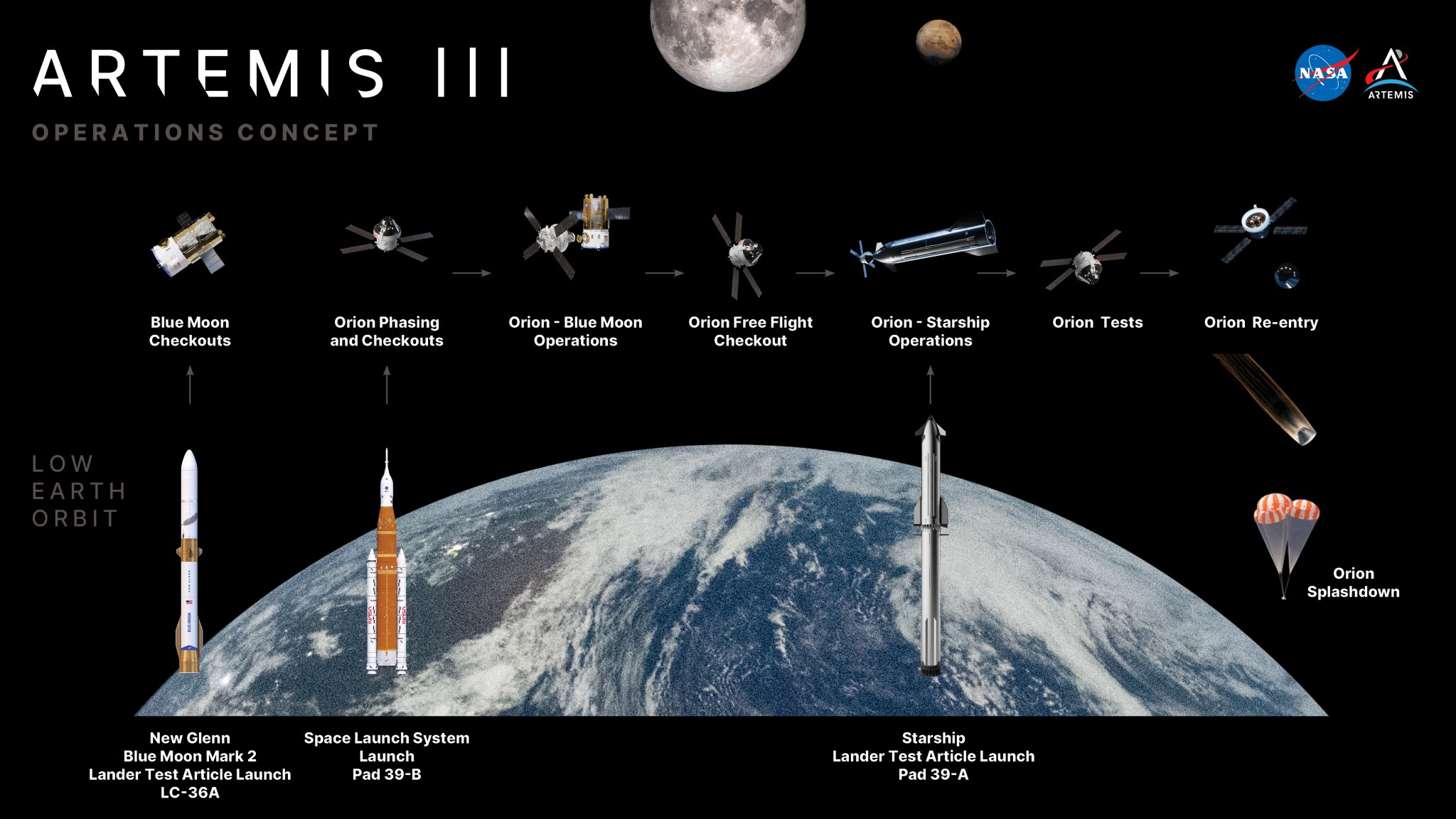
Unlike earlier Artemis missions that relied solely on NASA’s Space Launch System (SLS) rocket and Orion, Artemis III will feature three different spacecraft launched on separate rockets. The mission will kick off with a launch from Blue Origin, which will send its Blue Moon Mark 2 lander into a stable low Earth orbit, approximately 273 miles above the Earth.
Following the Blue Moon launch, NASA plans to send Orion atop the SLS rocket from Kennedy Space Center in Florida shortly afterward. Orion will initially enter an elliptical orbit before transitioning to a circular one for thermal stabilization as it prepares to rendezvous with the Blue Moon test article. This mission requires precise coordination of various orbital maneuvers and rendezvous tasks, marking a first for NASA in evaluating the interoperability of a commercial lunar lander and the Orion spacecraft in space.
Evaluating Lunar Lander Systems
During the initial phase of the mission, the crew will perform system checks and get ready for the critical docking with the Blue Moon test vehicle. Once they successfully dock, they will spend approximately two days aboard the lander, assessing the cabin environment and evaluating the life-support systems.
This Blue Moon test article incorporates numerous technologies and systems slated for future lunar missions, making it an essential component for validating the lander’s performance in an orbital environment. The data collected will be crucial for assessing spacecraft systems and crew operations that cannot be evaluated on the ground.
SpaceX’s Starship Docking Operations
After working with Blue Origin’s lander, Orion will undock and move to prepare for its second rendezvous with a SpaceX Starship Version 3 test article. This launch will occur later in the mission, allowing for efficient sequencing of docking tests. The Starship will enter a lower orbit optimized for communications and will feature a unique docking system for the upcoming test.
During this demonstration, Orion will dock with the Starship for up to two hours, focusing on how the two spacecraft interact as a combined system. The crew will not enter Starship during this phase; instead, the mission will evaluate controllability, communications, and docking dynamics. This dual docking approach allows NASA to gather valuable engineering data and insights into different operational concepts.
Data Collection for Future Missions
Artemis III will continue to yield critical data even after the docking operations conclude. After the Starship tests, the Orion spacecraft and its crew will have up to five days in orbit to complete various objectives that support subsequent Artemis missions. These include evaluations of the Orion Crew Survival System suits and a study on how astronauts can perform health assessments without direct communication with mission control, an important consideration for future lunar excursions.
Additionally, the mission will involve experiments related to cellular biology and the logistics of returning lunar samples to Earth. Astronauts will also engage in Earth and solar observations to enhance their observational skills, while plant seeds will be aboard Orion for scientific study.
Aiming for Lunar Exploration
Each activity during Artemis III is designed to lower risks associated with future lunar missions. The mission will provide NASA with hands-on experience in collaborating with commercial partners and managing complex docking operations among multiple spacecraft, yielding insights into mission coordination, communications, and overall spacecraft performance.
Ultimately, Artemis III aims to validate technologies and operational strategies that will be fundamental for future lunar crews. The lessons learned will guide the agency in refining its exploration plans and foster strong industry partnerships, ensuring astronauts are well-prepared for their next significant journey to the Moon. As part of a broader era of innovation and exploration, NASA is poised to establish a sustained human presence on the lunar surface, building towards its ambitious goal of sending humans to Mars.
Source: NASA