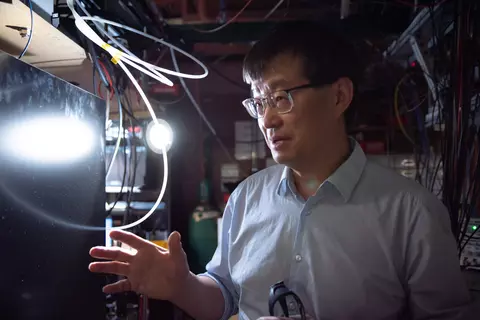
Photo: NIST
Jun Ye Receives Wolf Prize in Physics
Boulder, Colo. — Jun Ye, a physicist at the National Institute of Standards and Technology (NIST), has been honored with the 2026 Wolf Prize in Physics for his significant contributions to the field. This award is regarded as one of the most prestigious accolades in physical sciences, second only to the Nobel Prize in Physics. The recognition highlights Ye’s groundbreaking work in the control of ultracold atomic systems.
Ye, who is affiliated with JILA, a collaborative institute between NIST and the University of Colorado Boulder, shares the prize with Immanuel Bloch, the scientific director at the Max Planck Institute of Quantum Optics in Garching, Germany. The two scientists will equally divide the award, which amounts to $100,000.
In a statement, Ye expressed his gratitude for the honor, saying, “Honored and humbled, I wish to express my sincere gratitude to the Wolf Prize Committee.” He acknowledged the collaborative nature of his work, emphasizing the contributions of his mentors, colleagues, and students.
The physicist is renowned for developing optical atomic clocks that boast exceptional accuracy and stability. These advanced clocks are set to redefine international standards for time and frequency measurements. Ye and his team achieved these remarkable results through the use of ultrastable lasers and by meticulously controlling the interactions of laser-trapped atoms.
Innovative Research and Future Implications
Ye’s research extends beyond clock precision; it opens avenues for exploring fundamental physics. His work includes sensitive searches for the electron’s electric dipole moment, relativistic geodesy, and investigations into variations of fundamental constants.
Born in Shanghai in 1967, Ye spent much of his early life with his grandmother while his parents worked. Although she was illiterate, she inspired his curiosity by providing him with pencils and paper, encouraging him to document his interests. A pivotal moment in his education occurred during high school when a physics teacher recognized his talent and encouraged him to participate in a physics competition, which he won.
After obtaining a physics degree from Shanghai Jiao-Tong University, Ye moved to the United States in 1989. He joined JILA in 1992, where he studied under NIST physicist John Hall.
Ye has received numerous accolades throughout his career, including fellowship in the American Physical Society, membership in the National Academy of Sciences, and the American Academy of Arts and Sciences. In 2022, he was a co-recipient of the Breakthrough Prize in Fundamental Physics for his contributions to atomic clock technology, along with several other prestigious awards.
About the Wolf Prize
The Wolf Prize is an international award presented in Israel, recognizing living scientists and artists for their contributions to humanity and fostering friendly relations among people, regardless of nationality, race, or religious beliefs. This prestigious award has been given annually since 1978.
Source: NIST. Photo: NIST.