NASA Develops New Telescope for LISA Mission
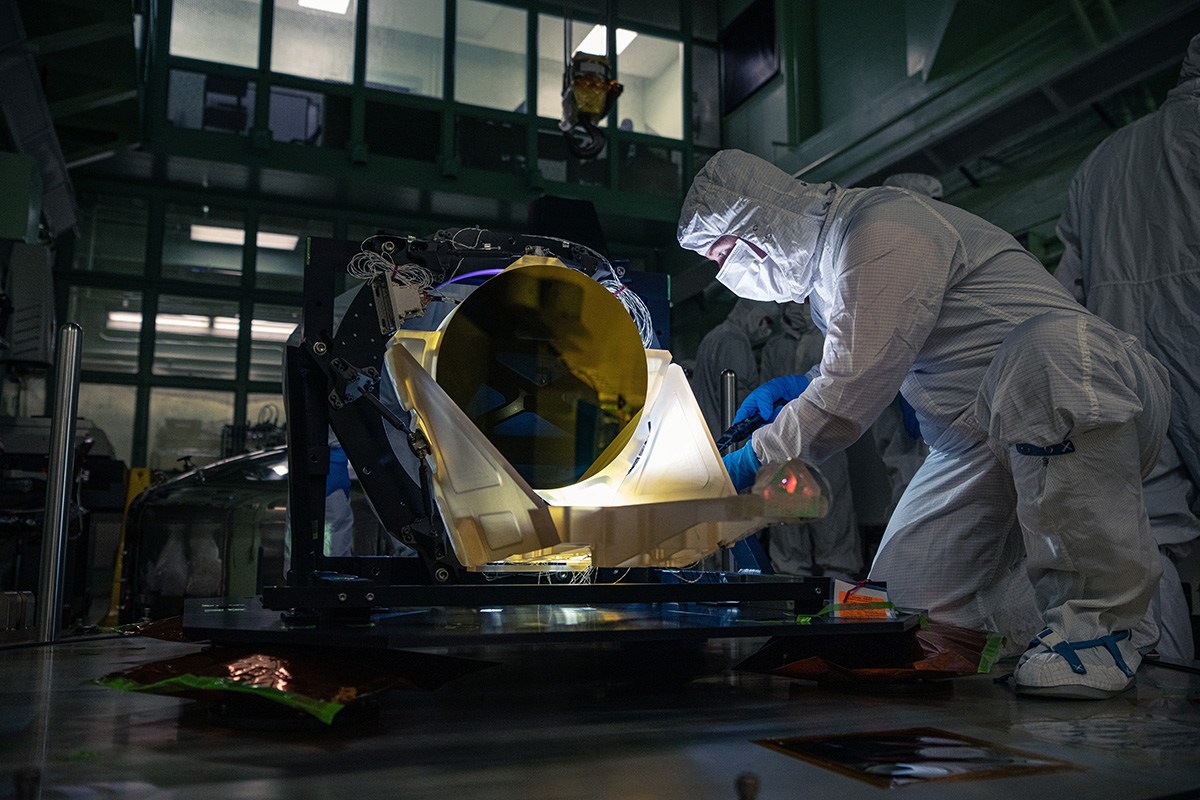
NASA is progressing in the development of a novel all-glass telescope intended for the Laser Interferometer Space Antenna (LISA) mission, which aims to identify gravitational waves—ripples in space-time. The Engineering Test Unit, designed, assembled, and integrated by L3Harris Technologies, marks a significant milestone toward producing the hardware necessary for flight.
The LISA mission, spearheaded by the European Space Agency (ESA), is set for launch in the mid-2030s. NASA’s role includes providing telescopes and additional essential equipment, along with engineering and scientific support, to enhance our understanding of the universe.
Telescope Design and Functionality
The mission will deploy three satellites into an orbit that follows Earth, forming a triangular configuration with sides measuring 1.6 million miles (2.5 million kilometers) each. Each spacecraft will be equipped with two telescopes that utilize infrared laser beams to send and receive signals between the satellites. This setup will enable the precise measurement of minute changes in distances, which correspond to the signals produced by passing gravitational waves.
Ira Thorpe, NASA’s project scientist for the mission at the Goddard Space Flight Center in Greenbelt, Maryland, noted that LISA will detect incredibly small variations, even smaller than the width of a helium atom. He described the mission’s potential to uncover low-frequency gravitational waves that are currently undetectable from Earth, including insights into mergers of supermassive black holes and other cosmic phenomena.
Innovative Materials and Testing
The telescopes will be constructed from a specialized amber-colored ceramic-glass material known as Zerodur, recognized for its stability across varying temperatures. In 2024, L3Harris delivered a prototype to NASA, which served as an engineering unit for the forthcoming telescope.
Ritva Keski-Kuha, who leads the LISA Telescope program at NASA Goddard, indicated that the prototype underwent extensive testing, and the lessons learned will inform the new telescope’s design. This upcoming unit represents the final pre-flight model and the first optical telescope to be delivered to ESA. Earlier in June, a structural model made from metal was provided to ESA.
Gravitational Wave Detection Capabilities
Gravitational waves, which were first theorized by Albert Einstein in 1916 and detected by ground-based observatories in 2015, occur when massive objects accelerate, such as binary stars orbiting each other. These waves travel through space-time at light speed and remain unaffected by intervening objects, making them valuable for cosmic exploration.
The LISA spacecraft will house a gold-platinum cube, referred to as a proof mass, which will float freely. The spacecraft will maneuver around the cube, ensuring that it falls solely under gravitational influence. ESA’s LISA Pathfinder mission, conducted in 2016, demonstrated the feasibility of minimizing non-gravitational forces on these proof masses, a crucial factor for detecting gravitational waves.
NASA’s contributions also encompass a laser system, devices to manage electric charge accumulation on the proof masses, data analysis capabilities for identifying gravitational wave sources, and additional scientific and engineering expertise.
For further details about the LISA mission, visit the NASA website.
Source: NASA. Photo: NASA.