Revolutionizing Optical Measurements
Researchers at the National Institute of Standards and Technology (NIST), along with their collaborators, have unveiled an innovative method for creating a compact tool for measuring light. This new device, which does not require large laboratory equipment, promises to enhance ultraprecise mobile timekeeping. Such advancements could play a crucial role in providing navigation signals for various vehicles, including drones, submarines, and cars, especially in scenarios where GPS may be inaccessible or disrupted.
Functionality of Microchip Frequency Combs
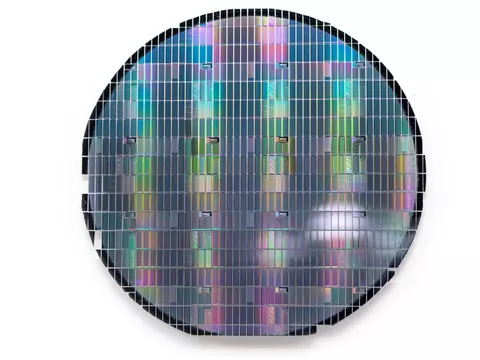
The technology, referred to as microchip frequency combs, generates a series of precise colors that serve as measuring points, akin to the markings on a ruler. These colors allow for highly accurate frequency measurements of light. At the core of this technology are tiny ring-shaped resonators, with each chip containing up to 300 of these components, all fabricated on wafers that can accommodate more than 400 chips.
Applications Beyond Timekeeping
Frequency combs are integral to the operation of optical atomic clocks, which are known for their exceptional timing accuracy. The new mobile optical clocks made possible by this technology could extend their utility beyond mere timekeeping to areas such as military navigation and resource exploration in oil, gas, and minerals.
Innovative Technique for Enhanced Precision
The NIST and JQI researchers employed a novel technique involving two lasers that send light around a minute ring called a microresonator. This interaction generates the uniform “tick marks” characteristic of a frequency comb. This method effectively circumvents issues faced by earlier designs that utilized a single laser, which often required additional power-consuming equipment to achieve stable and high-quality measurements.
Source: NIST