Researchers have developed a soft aquatic robot modeled after feather stars, marine invertebrates known for their unique movement capabilities. This innovative robot can navigate water in three dimensions, utilizing only two actuators for propulsion.
Jie Yin, a professor of mechanical and aerospace engineering at North Carolina State University and the paper’s corresponding author, noted the significance of this design. “One exciting aspect of this work is that it demonstrates how we can create robotic devices with an incredible range of motion using a minimum number of actuators, by taking advantage of intelligent design techniques,” he stated. Actuators are essential components that provide necessary force or torque in machines.
Mechanical Intelligence in Design
The feather star robot’s functionality is based on the principle of mechanical intelligence, which emphasizes how the structure of an object influences its behavior in interaction with the environment. This approach reduces the dependency on external controls from computers or users.
Yin explained that the feather star robot can move up and down, forward and backward, and rotate on its axis, capabilities typically requiring at least six actuators. However, the robot achieves these movements efficiently with just two actuators due to its innovative structural design.
Haitao Qing, the first author of the research and a postdoctoral researcher at UC Berkeley, pointed out a previous project that focused on a manta ray-inspired robot, which excelled in speed but lacked three-dimensional maneuverability. The goal of the current research was to create a robot that could maneuver more effectively with simpler mechanisms.
Robust Movement Modes
The feather star robot features four elastic “wings” attached to a central disk housing the two actuators. These wings are designed to bend and return to their original shape. Activating both actuators causes the wings to snap down, while deactivating them allows the wings to return to their upright position. Through rapid activation and deactivation, the robot can ascend in the water. Conversely, when both actuators are turned off, the robot descends. A slow wing flutter enables the robot to hover, a mode referred to as “jellyfish mode.”
To propel forward or backward, activating just one actuator causes one wing to flutter, functioning like a tailfin. This is termed “fish mode.” The robot can also rotate by alternating the activation of the two actuators, which is described as “rotor mode.” Yin emphasized that combining these three modes allows the robot to navigate in all three dimensions.
Applications and Future Directions
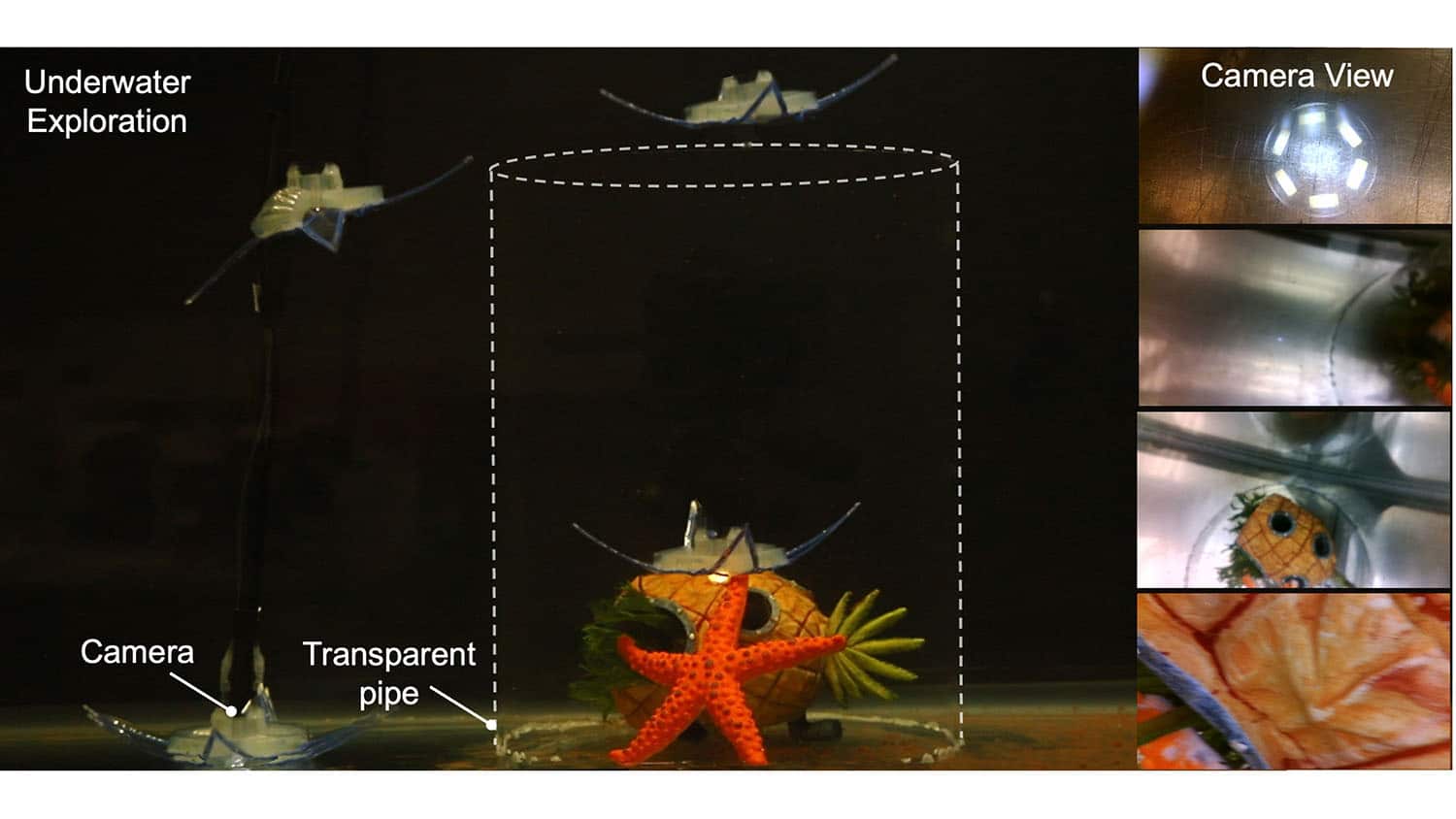
The research team demonstrated the robot’s potential by showcasing its ability to explore underwater environments using a camera or to lift objects while submerged, either independently or in collaboration with other robots. Qing remarked that this design presents a flexible platform for integrating with various technologies for different underwater applications. Future developments may include a fully wireless version of the robot.
The findings are detailed in the paper titled “Minimal-Actuation Feather Star–Inspired Soft Swimmers for Multimodal 3D Maneuverability,” published in the open-access journal Science Advances. Co-authors include Ph.D. students Caizhi Zhou and Haoze Sun from NC State, as well as collaborators from the University of Virginia and UC Riverside.
This research was supported by the National Science Foundation and the Office of Naval Research. Qing and Yin have filed a pending patent related to this innovative design.
Source: NC State University